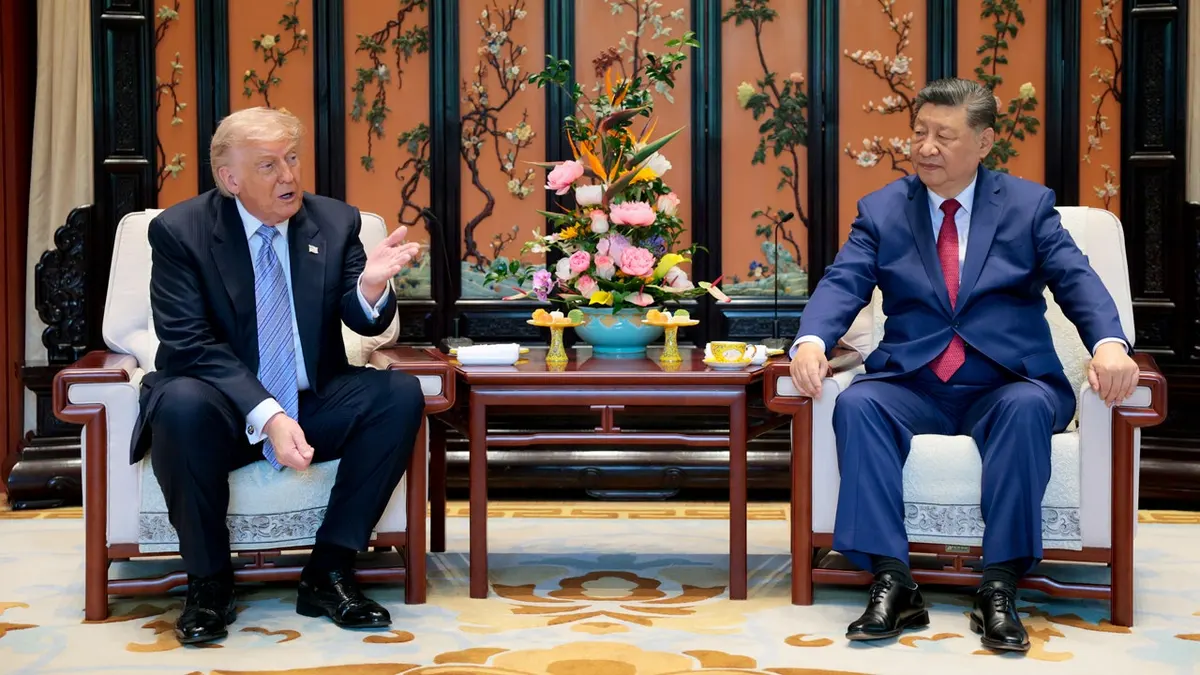
SouthernWorldwide.com – President Trump’s recent visit to Beijing has been met with criticism from liberal media outlets, who have largely declared the trip a failure. Publications like The New York Times have pointed to a lack of “breakthroughs” and have mocked Trump’s cordial remarks about President Xi Jinping.
This narrative of failure has been further fueled by the stock market’s dip following the visit. Fortune reported that the trade deals did not meet investor expectations, and notably, there was no progress on opening the Strait of Hormuz.
However, the article suggests that this assessment overlooks a crucial aspect: the message Trump conveyed to both President Xi and the Chinese populace. While not as dramatic as his 2017 decision to bomb Syria, Trump’s strategic inclusion of approximately 30 CEOs from leading American companies in the summit sent a powerful, unexpected signal.
This surprise move, featuring business titans who lead globally dominant corporations, served to remind the world of several key points:
- The U.S. is at the forefront of artificial intelligence (AI) innovation.
- The U.S. holds a dominant position in the energy sector.
- The U.S. economy remains unparalleled in its strength and resilience.
The Chinese, known for their adherence to strict schedules and pre-determined scripts, were reportedly taken aback by this deviation. Trump himself recounted to Sean Hannity how he proposed introducing the CEOs before the official meeting began, a suggestion that visibly surprised the Chinese delegation.
This unexpected introduction disrupted the planned agenda, forcing the Chinese leadership to engage with topics not originally slated for discussion. Trump explained that this adjustment allowed them to discuss subjects that were not initially anticipated.
By orchestrating this surprise, Trump effectively seized control of the summit’s narrative, even on Chinese soil. While the Chinese dignitaries may have adapted, the article posits they were displeased by this shift in dynamics.
Therefore, claims by outlets like CNN that Xi “set the tone” of the summit are contested. The article argues that Xi’s stern warnings regarding Taiwan were largely a performance for his domestic audience, intended to counter Trump’s assertive approach and his efforts to reconfigure China’s alliances.
The piece highlights that China has been experiencing setbacks in its geopolitical influence and its pursuit of technological supremacy. Trump’s administration has notably weakened Venezuela, a key ally for China in the Americas, and is working to support Cuba’s transition away from Chinese-backed communism.
Baca juga di sini: JT Ginn's No-Hitter Broken in 9th, Angels Win on Walk-Off Home Run
Furthermore, the U.S. has exerted significant pressure on Iran, impacting its oil exports, which are crucial for China’s energy imports. The ongoing conflict in Ukraine, where Russia is reportedly facing difficulties, also indirectly affects China, as Russia is an ally.
The core message of Trump’s visit, the article contends, was to underscore America’s dominance in critical contemporary industries, which is fundamental to its economic growth and global power.
China, conversely, has struggled to meet the objectives of its recent five-year plans. These plans have aimed to boost domestic consumption, reduce reliance on exports, and curb debt-driven infrastructure spending, yet none have been fully achieved.
The current five-year plan emphasizes self-reliance and technological advancement, paradoxically seeking foreign investment to achieve these goals. However, with global pushback against China’s intellectual property theft and unfair trade practices, securing such investment is becoming increasingly difficult. The U.S. is actively hindering China’s AI development by restricting access to advanced chips, and Europe is scrutinizing Chinese electric vehicle imports.
China’s economic slowdown is attributed to several factors, including weak consumer demand, a prolonged property crisis, and a declining population. Reports indicate a decline in investment in housing, manufacturing, and infrastructure, key drivers of economic growth.
The government has set its lowest economic growth target in decades, signaling concerns about its economic trajectory. This follows several years where the targeted growth rate was not consistently met.
Some of these economic challenges are linked to the leadership of President Xi, whose direct involvement in economic management has not yielded the desired results. The article also notes that Xi’s government has created an environment of fear, with numerous business leaders either imprisoned or having “disappeared,” contributing to corporate uncertainty.
For the past two decades, the liberal media has, according to the author, consistently overestimated China’s economic potential while overlooking the limitations of its centralized, top-down economic model. Predictions of China surpassing the U.S. as the world’s largest economy have not materialized.
In contrast, the U.S. economy, driven by innovation, opportunity, and a system that rewards success, has consistently outperformed other nations.
President Trump’s trip to Beijing, the article concludes, served to reinforce this fundamental truth—a message that the liberal media may have overlooked, but which the Chinese people likely understood.