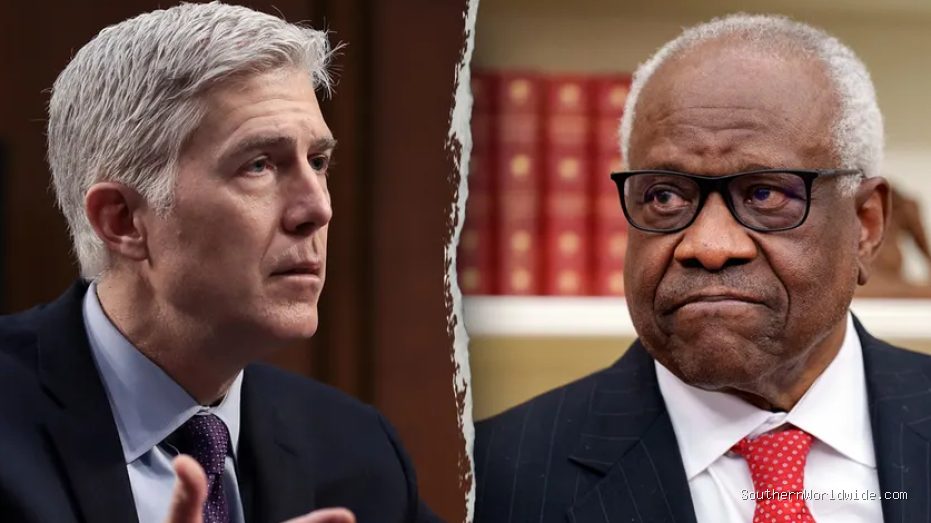
SouthernWorldwide.com – Two conservative justices on the Supreme Court have voiced their dissent regarding the majority’s decision not to review a defamation case brought by attorney Alan Dershowitz against CNN. They argue that the court missed a crucial opportunity to re-examine a significant defamation precedent established in the 1960s.
This dissent from the conservative wing of the court essentially urged the justices to reconsider long-standing libel laws. Their stance aligns with President Donald Trump’s calls from 2016 to relax U.S. libel laws.
Dershowitz, who has represented prominent figures such as Trump, O.J. Simpson, and Leona Helmsley, contended that CNN deliberately edited a segment of his defense during Trump’s first impeachment trial. The edited clip, which concerned “quid pro quo” arrangements, allegedly made it appear as though he stated the opposite of his actual, more comprehensive remarks, thereby damaging his reputation.
Justices Clarence Thomas and Neil Gorsuch, appointed by Presidents George H.W. Bush and Trump respectively, criticized their colleagues for adhering to the “actual malice” standard when assessing CNN’s alleged defamation of Dershowitz. They argued that this standard lacks constitutional basis and was instead introduced by the Supreme Court in its pivotal 1964 ruling in *New York Times Co. v. Sullivan*.
The conservative justices wrote that it was “predictable” that Dershowitz would not succeed under the demanding standard established in *New York Times* Co. v. Sullivan. They noted that Dershowitz was now asking the Court to overturn Sullivan and related precedents.
Dershowitz himself stated on Monday that all the judges agreed CNN had misrepresented him. However, he elaborated that the majority ruled, despite dissenting opinions, that he was required to prove actual malice with clear and convincing evidence. He described this as an “impossible standard” that he believes will eventually be overturned.
The *Sullivan* case originated when a commissioner from Montgomery, Alabama, filed a libel suit against *The New York Times*. This lawsuit was in response to a full-page advertisement that criticized the city’s handling of civil rights protesters.
An Alabama jury awarded damages to L.B. Sullivan, even though he was not explicitly named in the advertisement. Subsequently, the Supreme Court overturned this ruling. The Court held that a public official cannot win a defamation case unless they can prove the statement was made with “actual malice”—meaning the speaker knew it was false or acted with reckless disregard for the truth.
In their written opinion concerning Dershowitz’s case, Justices Thomas and Gorsuch asserted that the “actual-malice standard for public figures bears no relation to the text, history, or structure of the Constitution.” They suggested that, if anything, the founding generation believed that public figures should have stronger grounds for damages when defamed.
As a historical illustration, Thomas and Gorsuch pointed to the Sedition Act of 1798. This act established a significantly lower threshold for what constituted defamatory statements against public officials.
Under this law, then-Rep. Matthew Lyon of Vermont was prosecuted. This occurred during a period of American tension with France, and Lyon had characterized President John Adams as someone possessing an “unbounded thirst for ridiculous pomp, foolish adulation and selfish avarice.”
President Thomas Jefferson allowed the Sedition Act to expire in 1801 and subsequently pardoned many individuals who had been prosecuted under its provisions.
More recently, President Trump has advocated for the relaxation of U.S. libel laws, echoing concerns similar to those expressed by Justices Thomas and Gorsuch regarding the Supreme Court’s defamation jurisprudence.
During his 2016 presidential campaign, Trump pledged to “open up our libel laws” if elected. His intention was to pursue legal action against what he frequently labeled as “fake news” outlets.
Trump stated that journalists who “write purposefully negative and horrible and false articles — we can sue them and win lots of money.”
He has often singled out CNN for criticism more than other news organizations. Notably, he frequently engaged in public disputes with its then-White House correspondent and podcaster, Jim Acosta.
During a 2017 news conference, Acosta repeatedly interrupted Trump. The president responded by telling Acosta not to be rude and informed him he would not be taking a question from him because, in Trump’s words, “you are fake news.”
At the 2016 event, Trump declared, “We’re going to open up libel laws, and we’re going to have people sue you like you’ve never got sued before.” He also specifically mentioned *The New York Times* and *The Washington Post* at that time.
The recent ruling, coupled with Trump’s own lawsuit against CNN (founded by Ted Turner) over the network’s use of the term “Big Lie” to describe his claims about the 2020 election results, leaves open the possibility that the Supreme Court could revisit the *Sullivan* precedent. However, such a significant shift in legal precedent appears unlikely in the immediate future.