SouthernWorldwide.com – President Donald Trump’s suggestion on Friday that U.S. arms sales to Taiwan could be used as a bargaining chip in broader negotiations with China has triggered a strong reaction from Taiwan’s president and reignited discussions in Washington regarding the future direction of U.S. policy towards the island.
Taiwanese President Lai Ching-te responded hours later, emphasizing that U.S. arms sales are “the most vital deterrent” against regional conflict and asserting that Taiwan “shall never be sacrificed or traded away.”
Trump’s remarks emerged as the administration continues to hold up a $14 billion Taiwan weapons package, initially approved in principle in late 2025. This delay has fueled a growing debate in Washington about whether Trump is shifting U.S. policy back towards a more traditional “strategic ambiguity” or adopting a more openly transactional approach, linking Taiwan’s support to wider negotiations with Beijing.
CHINA PROMISES ‘COUNTERMEASURES’ TO US ARMS SALE TO TAIWAN
Prior to Trump’s recent summit with Chinese President Xi Jinping, bipartisan lawmakers had cautioned in a letter that “American support for Taiwan is not up for negotiation.”
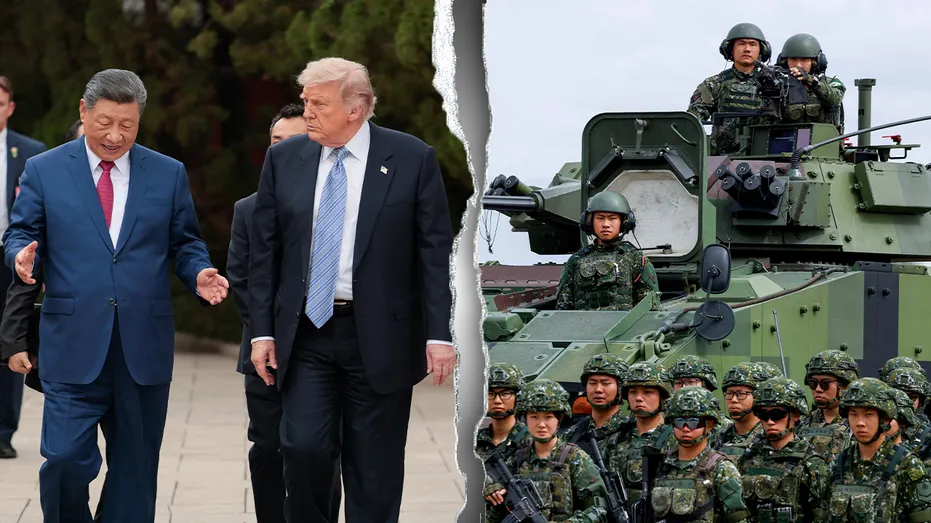
The issue of Taiwan had already surfaced as one of the most sensitive points of contention surrounding Trump’s mid-May summit with Xi in Beijing.
Following their meeting, China’s foreign ministry reported that Xi had warned Trump that Taiwan remains the “most important issue” in U.S.-China relations and cautioned that mishandling it could lead to “clashes and even conflicts” between the two global powers.
For many decades, U.S. policy concerning Taiwan has adhered to a stance of “strategic ambiguity.” This approach involves supporting Taiwan’s self-defense capabilities while deliberately avoiding an explicit commitment to militarily defend the island in the event of an attack from China.
Trump’s comments elicited mixed responses from foreign policy analysts. Some China hawks expressed concerns that treating Taiwan arms sales as negotiable could undermine deterrence and create instability among U.S. allies in the Indo-Pacific region. Conversely, others argued that the remarks indicated a return to a more traditional interpretation of strategic ambiguity, moving away from the increasingly explicit signals from the U.S. towards Taiwan in recent years.
TAIWAN RAMPS UP COAST GUARD AND MILITARY READINESS IN FACE OF BEIJING’S ‘GRAY ZONE’ WARFARE
“Trading Taiwan’s security for rhetoric from Beijing would be a strategic blunder of historic proportions,” stated retired Rear Adm. Mark Montgomery, a senior fellow at the Foundation for Defense of Democracies think tank. He added, “If the president does not proceed with the arms sale to Taiwan, he will jeopardize U.S.–Taiwan relations and weaken U.S. credibility globally.”
Bonnie Glaser, managing director of the Indo-Pacific Program at the German Marshall Fund think tank, contended that Trump’s remarks blurred a critical distinction central to the long-standing U.S. policy on Taiwan.
Read more : Apologies and Money for Alleged 'Weaponization' Victims in Billion-Dollar Trump Settlement
However, some foreign policy analysts suggested that Trump’s comments signaled a deliberate effort to reorient U.S. policy with a focus on American priorities.
TRUMP LEAVES CHINA WITH BREAKTHROUGHS — AND UNFINISHED BUSINESS ON XI’S BIGGEST FIGHTS
Goldstein argued that Trump’s statements reflected a return to a more measured interpretation of “strategic ambiguity,” especially when contrasted with the Biden administration’s approach, which he characterized as “lurching dangerously toward ‘strategic clarity,’ that threatened to spark a near-term U.S.–China war.”
During his presidency, former President Joe Biden repeatedly indicated that the United States would militarily defend Taiwan if attacked by China. Critics argued these comments pushed Washington closer to “strategic clarity,” despite White House officials maintaining that no formal policy change had occurred.
Critics contended that Biden’s remarks escalated tensions with Beijing, while supporters believed they strengthened deterrence against potential Chinese aggression.
Goldstein posited that Trump’s openness to discussing Taiwan arms sales within the framework of broader U.S.-China negotiations signifies a more restrained strategy aimed at maintaining stability between Washington and Beijing.
“Indeed, with these fresh comments Trump recognizes that both sides are responsible for maintaining peace across the Taiwan Strait,” Goldstein remarked. “He even went so far as to sternly admonish the leadership in Taipei for unnecessary risk-taking.”
Trump has historically adopted a more transactional stance on Taiwan compared to many traditional U.S. foreign policy hawks. He has previously argued that Taiwan should compensate the United States for its defense and has accused Taiwan of “stealing” America’s semiconductor industry.
Furthermore, he has frequently framed Taiwan in the context of semiconductor competition and supply chain dependence, advocating for the U.S. to regain a larger share of advanced chip manufacturing.
“Trump’s new reflections on Taiwan illustrate an informed approach that recognizes the basic and fundamental truth that Taiwan is not a vital U.S. national security interest and that the U.S.-China relationship far outweighs the U.S.-Taiwan relationship in importance,” Goldstein elaborated.
The paramount question now confronting lawmakers and U.S. allies is whether Trump’s rhetoric will ultimately influence the timing or conditions of the pending Taiwan weapons package. This is a development that many analysts view as crucial for understanding the administration’s future approach to Taiwan.