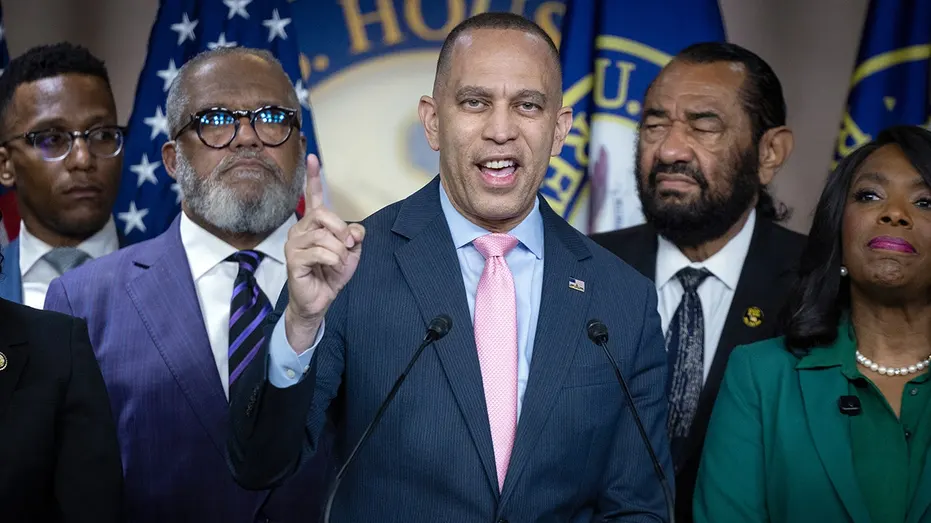
SouthernWorldwide.com – Virginia Republicans have vehemently criticized national and state Democrats for what they deem “insane” proposals to overturn the Supreme Court of Virginia’s 4-3 ruling against their redistricting plan. The backlash specifically targets House Minority Leader Hakeem Jeffries and other national Democrats for their recent intervention.
A report from The New York Times on Monday detailed a meeting between national and Virginia Democrats to explore avenues for reviving their now-blocked 10-1 map, a move that has drawn sharp condemnation.
“It is insane — that is my initial reaction, because it would be absolutely crazy to discard judges for making the correct decision,” stated Virginia House Minority Leader Terry Kilgore, a Republican from Gate City.
“That would be beyond unacceptable. I believe many Virginians would see through such an action. Furthermore, it is legally too late for them to pursue this given the May 12 pre-primary deadline,” he added.
The New York Times report suggested that Jeffries, a Democrat from New York, was involved in discussions that included lowering the retirement age for state justices. Other proposals reportedly ranged from re-trying the case before a court specifically chosen by the Democrats to utilizing the ruling from Tazewell County, which was generally favorable to Republicans.
The Tazewell decision, issued by Judge Jack Hurley, initially invalidated the redistricting referendum. However, the Supreme Court of Virginia (SCOVA) later allowed the vote to proceed. The Times indicated that Democrats are contemplating using Hurley’s reasoning to instead invalidate the 2020 referendum that established the independent redistricting commission. This commission was the very body the Democrats attempted to bypass with their April vote.
“This clearly demonstrates how power-hungry Hakeem Jeffries and his fellow Democrats are. I am pleased that the Supreme Court upheld the rule of law, and it was a positive day for Virginia,” Kilgore remarked.
Democrats, however, have a different perspective. Virginia Senate Majority Leader Scott Surovell, a Democrat from Mount Vernon, announced that an emergency application for relief had been filed with the Supreme Court of the United States by late Monday.
In a statement, Surovell specified that the application was submitted by himself, along with House Speaker Don Scott (D-Portsmouth) and Senate President Pro Tempore L. Louise Lucas (D-Portsmouth).
Critics have pointed to the haste with which the case was filed, noting several apparent typos on the first page of the filing. The case was submitted to the Supreme Court of the United States, but the document itself, in its second reference, mistakenly indicated it was filed to the “Supreme Court of Virginia.”
Senate Minority Leader Ryan McDougle, R-Hanover, who was the original plaintiff, was referred to as a “Sentator.” This error led to widespread mockery on X, with some users creating memes and a Virginia political commentary account even renaming itself “Virgnia Sentator” due to this and a second misspelling in Scott’s title.
In a statement following the initial ruling, Scott said he “respect[ed]” the decision. He also stated that the close vote indicated Virginians wished to “fight back” against President Donald Trump. He further asserted that Virginia Democrats would “keep fighting for a democracy where voters — not politicians — have the final say.”
Rep. Ben Cline, a Republican from Virginia whose Shenandoah Valley district was slated to be divided into three parts, echoed Kilgore’s sentiments in a statement. He said that Jeffries and national Democrats were “furious” at SCOVA for “up[holding] the rule of law.”
Cline urged Virginians to become more involved in politics, warning against what he described as an “illegal” Democratic effort to “reshape the maps.”
Kilgore dismissed the notion of using the Tazewell ruling to dismantle the redistricting commission as a desperate attempt, often referred to as “grasping at straws.” He pointed out that the panel had already drawn state-legislative districts without any challenges.
Amidst the ongoing political dispute, lawmakers in neighboring West Virginia have initiated a proposal to allow some of Virginia’s more conservative, rural communities to secede and join the Mountaineer State. This mirrors West Virginia’s own secession from Virginia on June 20, 1863.
Kilgore’s delegate district encompasses a significant portion of the mountainous region that proponents of secession in Charleston have highlighted. However, Kilgore expressed his view that this idea is “a little bit premature.”
“I took an oath to uphold the Constitution of Virginia, and I am going to remain here and work to reclaim Virginia,” Kilgore stated.
“We can reclaim Virginia. As you saw from the close vote on the yes-no referendum, that is where Virginians stand. We are a closely divided state; we are a purple state.”
Read more : Fetterman Reacts to PA Supreme Court Justice's Alleged Departure from Democrats Over Antisemitism
Kilgore anticipates that Virginia voters will “swing back hard” towards Republicans as a reaction to the political maneuvering observed this year. He believes this could create a significant shift in the purple state’s political landscape, potentially impacting the Republican effort to retain control of the House of Representatives in November.