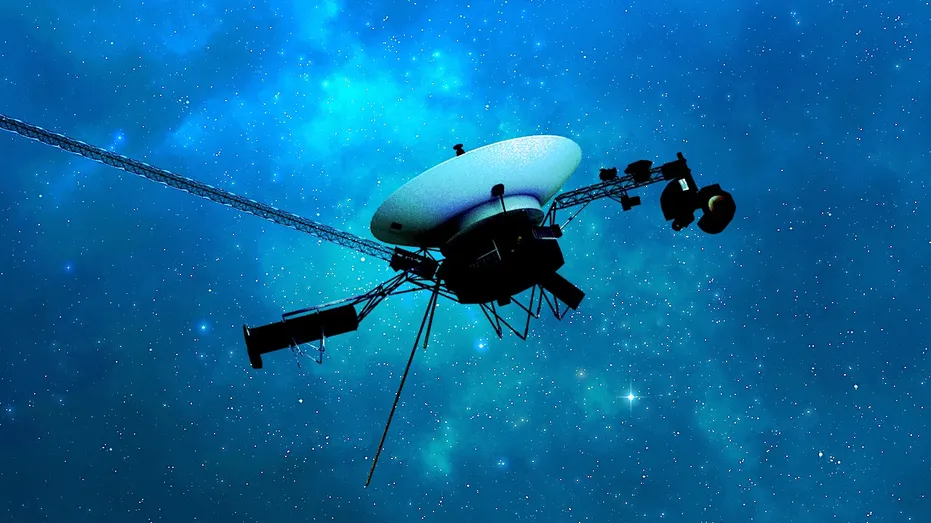
SouthernWorldwide.com – NASA has made the strategic decision to deactivate one of the scientific instruments aboard the Voyager 1 spacecraft. This measure is crucial for conserving its diminishing power supply, ensuring the longevity of the nearly 49-year-old probe as it continues its unprecedented journey through interstellar space, a staggering 15 billion miles away from Earth.
Engineers at NASA’s Jet Propulsion Laboratory (JPL) in Southern California issued commands on Friday to power down the Low-Energy Charged Particles (LECP) experiment. This instrument, a veteran of the Voyager mission, has been operational almost continuously since the spacecraft’s launch in 1977.
This move is necessitated by the gradual power loss experienced by the nuclear-powered probe, which depletes approximately 4 watts of power annually. Mission managers are diligently working to extend its operational lifespan.
Kareem Badaruddin, Voyager mission manager at JPL, stated that while shutting down a science instrument is not ideal, it represents the best available course of action. He emphasized that Voyager 1 still retains two functioning science instruments: one dedicated to plasma wave detection and another for magnetic field measurements. These instruments are performing exceptionally well, transmitting valuable data from a region of space yet to be explored by any other human-made craft.
The shutdown highlights the increasingly complex challenge faced by the Voyager team as both spacecraft age significantly beyond their initial mission parameters.
Voyager 1 and its twin, Voyager 2, are powered by radioisotope thermoelectric generators. These devices convert the heat generated by decaying plutonium into electrical energy. After almost five decades in space, engineers have had to systematically reduce power to heaters and instruments. This is done while ensuring that the spacecraft do not become so cold that critical systems, including fuel lines, are compromised.
“The team remains focused on keeping both Voyagers going for as long as possible,” Badaruddin added.
The urgency to act intensified following an unexpected power drop experienced by Voyager 1 during a routine roll maneuver on February 27th, according to NASA.
Engineers expressed concern that any further power reduction could activate the spacecraft’s undervoltage fault protection system. This system is designed to automatically shut down components to safeguard the probe. Recovering from such a fault can be a protracted process and carries inherent risks, prompting the team to intervene proactively rather than wait for the spacecraft to initiate the shutdown itself.
The two Voyager probes continue to be the sole spacecraft positioned far enough from Earth to gather data on “detecting pressure fronts and regions of varying particle density in the space beyond our heliosphere,” as stated by NASA.
“Engineers are confident that shutting down the LECP will provide Voyager 1 with approximately one year of additional operational time,” a NASA press release indicated. “They are utilizing this period to finalize a more comprehensive energy-saving solution for both Voyagers, which they have dubbed ‘the Big Bang,’ aimed at further extending Voyager’s operational capabilities.”
“The concept involves simultaneously deactivating a group of powered devices – hence the nickname – and replacing them with lower-power alternatives. This will help maintain sufficient warmth within the spacecraft to continue gathering scientific data,” the release elaborated.
The decision to power down the LECP was not made hastily. NASA confirmed that mission science and engineering teams had established years prior the sequence in which spacecraft systems would be deactivated as available power decreased. Of the ten original instrument sets aboard the twin probes, seven have now been switched off. Voyager 2’s LECP instrument was similarly shut down in March 2025.
Read more : IV Therapy and Supplements Face Expert Scrutiny Over Potential Side Effects
Given that Voyager 1 is now over 15 billion miles from Earth, commands take approximately 23 hours to reach the spacecraft. The shutdown sequence itself requires more than three hours to complete. A minor component of the LECP system—a small motor responsible for rotating the sensor to scan in all directions—will remain powered. This component consumes a minimal amount of power, about half a watt. Engineers are hopeful that this could preserve the possibility of reactivating the instrument in the future should additional power become available.