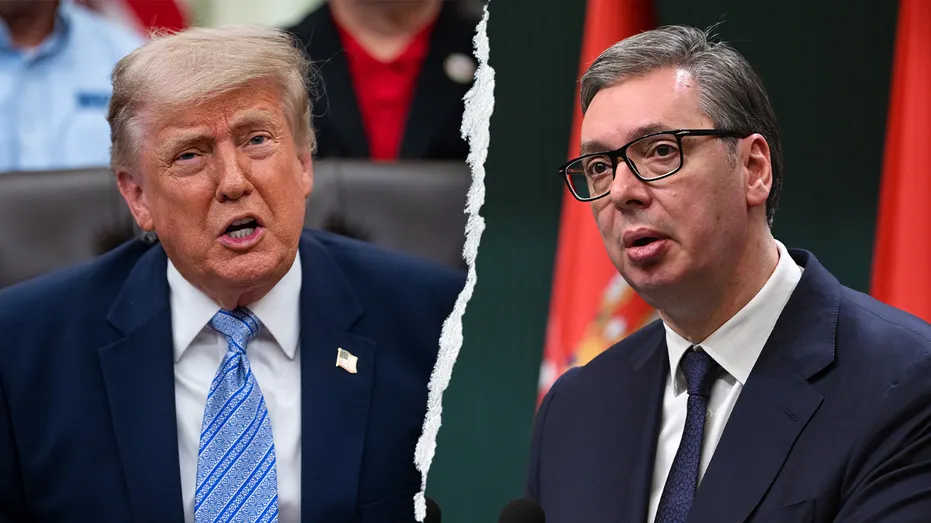
SouthernWorldwide.com – Serbian President Aleksandar Vučić has stated that relations between Serbia and the United States have experienced a significant positive change during the presidency of Donald Trump. This shift, he believes, has altered public opinion in Serbia, a nation still deeply affected by the memory of the 1999 NATO bombing campaign.
Vučić indicated that a comparison of public sentiment towards the Clinton and Trump administrations, or Democrats versus Republicans, would reveal an overwhelming preference for the latter in Serbia. He estimated this preference to be as high as 90-10 or even 95-5.
This sentiment is particularly noteworthy given Serbia’s historical context. Many Serbians still associate the United States with the 1999 NATO bombing, an intervention launched during the Kosovo conflict to halt Serbian forces’ actions against ethnic Albanians. This event remains a pivotal moment in modern Serbian history.
The Serbian President revealed that he recently extended an invitation to Donald Trump to visit Belgrade. Vučić expressed his conviction that Trump would be met with a highly enthusiastic reception.
“I hope that we’ll be able to host him,” Vučić stated. He anticipates that the welcome would exceed expectations, potentially drawing “more than hundreds of thousands of people.”
According to Vučić, the strengthening relationship between Washington and Belgrade is increasingly focused on economic ties, investment, and technological collaboration, alongside shared conservative values.
He further elaborated that Serbia and the United States are in the process of establishing a strategic dialogue. This dialogue will encompass key areas such as energy, infrastructure, artificial intelligence, defense cooperation, and investment opportunities.
Discussions are reportedly underway for projects including energy infrastructure development, cooperation on liquefied natural gas, and the establishment of data centers and advanced computing technologies.
This burgeoning relationship coincides with Serbia’s strategic aim to establish itself as a regional economic center. Simultaneously, the country continues to pursue its long-held objective of joining the European Union.
As evidence of Serbia’s growing international standing and economic aspirations, Vučić pointed to the preparations for Expo 2027 in Belgrade, which is expected to host nearly 150 participating countries.
Vučić, who has been a dominant political figure in Serbia since becoming prime minister in 2014 and president in 2017, highlighted the country’s economic progress as a testament to its transformation. He noted that Serbia’s GDP has grown from 32 billion euros when he took office as prime minister to an projected figure exceeding 100 billion euros, equivalent to $120 billion, for the current year.
Vučić’s connection with Trump dates back to Trump’s initial term, during which the White House facilitated a series of economic normalization agreements between Serbia and Kosovo. Instead of immediately addressing the politically sensitive issue of Kosovo’s status, the Trump administration prioritized infrastructure projects, transportation links, and investments designed to improve relations between the two parties.
In September 2020, Vučić and then-Kosovo Prime Minister Avdullah Hoti signed U.S.-brokered economic agreements at the White House. These agreements included commitments to enhance rail and highway connectivity and to stimulate investment. Trump characterized the deal as a significant achievement, attributing its success to a focus on “job creation and economic growth” rather than lingering political disputes.
When questioned about the possibility of recognizing Kosovo, which declared independence from Serbia in 2008 and has since been recognized by the United States and most European nations, if such a move would benefit Serbia’s economic future and accelerate its EU accession, Vučić pushed back against the premise.
He argued that economic cooperation and improved relations should precede discussions regarding political status. “I’m not saying that I’m ready to violate my constitution… I have always been open to talks or compromising solutions, I have always been open to developing great economic ties and no doubt much better political ties. But I was not speaking about recognition of someone’s independence,” he stated.
While Serbia actively seeks membership in the European Union, it has also maintained relationships with Russia and China. This balancing act has faced increased scrutiny amidst Russia’s ongoing war in Ukraine and escalating global geopolitical tensions.
Addressing the question of whether Serbia can continue to navigate between East and West in an increasingly polarized world, or if it will eventually be compelled to choose a side, Vučić rejected the notion that nations must align with specific geopolitical blocs.
Instead, he cited his own visit to China and Trump’s engagement with Beijing as examples of a pragmatic diplomatic approach centered on national interests. “President Trump didn’t go there because of his vanity,” Vučić remarked regarding Trump’s trip to China. “He brought with him all the leading people of the United States of America for making better businesses, for earning more money for their companies.”
Vučić indicated that he adopts a similar strategy during his own travels, asserting that leaders should prioritize economic opportunities for their citizens over ideological affiliations. “I’m coming from a small country. I was asking for more investments and was fighting for the interests of my people,” he explained.
The Serbian President believes that this pragmatic approach should also guide efforts to resolve ongoing conflicts in both Ukraine and the Middle East. “It’s always better to have thousands of days of negotiations than one day of war,” he emphasized.
Regarding tensions involving Iran and the broader Middle East conflict, Vučić reaffirmed Serbia’s support for Israel. This stance notably sets Belgrade apart from several European governments.
“I am the president of the country that is one of the very rare countries in Europe that is not hesitating to cooperate and collaborate with Israel,” he declared. “And it is proud to say this publicly and openly.”
Vučić expressed concern over what he described as the global rise of antisemitism. “From time to time, I’m very much afraid to see a lot of antisemitic slogans and antisemitic banners,” he stated.
He affirmed that Serbia has resisted these trends and pledged that this resistance would continue under his leadership. “It does not happen in Serbia, and it won’t happen as long as I’m the president,” Vučić concluded.