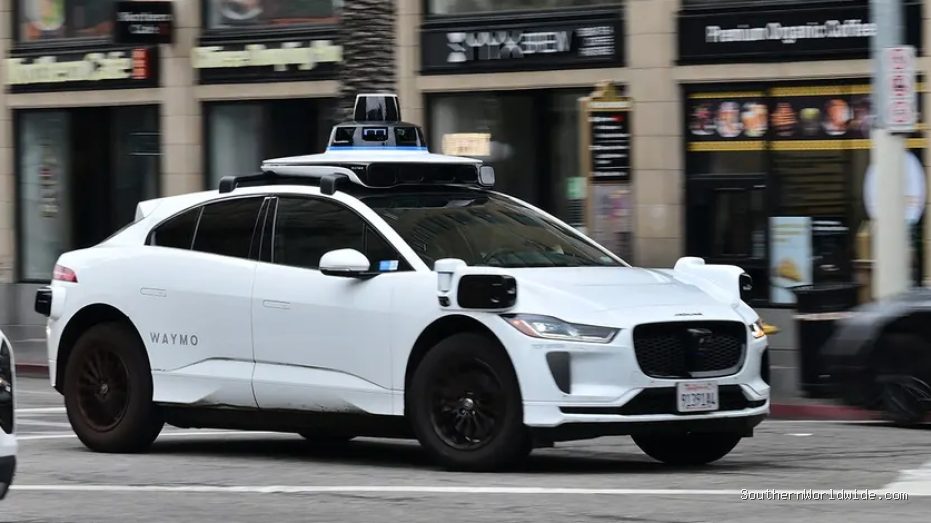
SouthernWorldwide.com – A new dimension has been added to the age-old crime of burglary, with authorities in San Francisco reporting an incident where a self-driving car was allegedly used as a getaway vehicle.
This unprecedented event occurred outside Hot 8 Yoga in the city’s Marina district. According to police records, a burglar entered the studio, stole activewear, and exited the premises in less than three minutes.
The suspect then reportedly loaded the stolen clothing into the trunk of a waiting Waymo robotaxi and departed the scene. The vehicle, lacking a human driver, seemingly completed the ride request without intervention.
This unique situation raises significant questions regarding the role of autonomous vehicles in crime scenes, privacy concerns, and the challenges faced by law enforcement in gathering evidence.
The suspect allegedly utilized the autonomous vehicle in a manner similar to a conventional ride-hailing service. The Waymo vehicle dropped the individual off near the yoga studio, waited during the commission of the burglary, and then provided transportation away from the scene.
The absence of a driver meant there was no one to observe the suspicious activity of loading stolen goods or to question the situation. The car, by its programming, simply followed the established ride request.
The San Francisco Police Department confirmed that officers responded to a business on January 9, 2026, following a report of a burglary that took place around 4:07 a.m. An employee reported that an unknown suspect had burglarized the establishment, stolen items, and fled in a vehicle.
SFPD has classified the case as an “open and active investigation,” stating that no arrests have been made at this time. The department is urging anyone with information to contact them at 415-575-4444 or text a tip to TIP411, starting the message with SFPD.
Investigators believe this may be the first documented instance in San Francisco where a self-driving car was used to escape a crime scene. The stolen items reportedly included men’s shorts, adding a peculiar detail to the already unusual case.
At first glance, this case might seem straightforward to solve, given that Waymo vehicles are equipped with cameras and riders typically require accounts with associated payment information, suggesting a clear digital trail.
However, the investigation encountered immediate obstacles. Police reportedly obtained a search warrant for Waymo account information and vehicle footage.
The detective leading the case indicated that the account information did not lead to the identification of the suspect. Furthermore, the company no longer possessed interior footage by the time the warrant was executed months later.
The exterior footage presented its own set of challenges, with faces blurred for privacy reasons. This situation highlights a potential conflict where privacy protections, designed to safeguard innocent bystanders, could inadvertently hinder the identification of criminal suspects.
Waymo declined to comment on the specific burglary. However, the company stated that it rigorously reviews all law enforcement requests to ensure compliance with applicable laws and valid legal bases.
Waymo further clarified that it does not employ facial recognition or other biometric identification technologies. The company’s cameras and sensors are primarily used to enable safe navigation and improve the autonomous driving system.
This technology allows the vehicle to recognize the presence of people but does not link them to specific identities. This distinction is crucial in cases where identifying a suspect is paramount.
The complexity arises from balancing the need for effective law enforcement evidence with the imperative to protect individual privacy and prevent autonomous vehicles from becoming ubiquitous surveillance devices.
This incident illustrates how conventional criminal activities can intersect with rapidly advancing technology. Previously, a getaway might have involved a human accomplice, a taxi, or a stolen vehicle.
Now, a driverless ride can be summoned via an app, allowing for an escape without any direct interaction with a human driver.
This presents a significant challenge for law enforcement. If the ride was booked using stolen credentials or a burner phone, the account information may not directly identify the perpetrator.
Moreover, despite the presence of numerous cameras, the footage may not always provide the crucial evidence investigators require.
The assumption that more cameras equate to more answers is challenged by this case. If critical video is deleted, faces remain obscured, or account information proves unhelpful, a technologically advanced getaway vehicle may still necessitate traditional detective work.
For residents or travelers in areas where robotaxis operate, this story serves as a significant point of awareness. These vehicles are no longer confined to limited testing grounds; they are actively transporting passengers and, as demonstrated, have now become involved in criminal investigations.
The implications are far-reaching: a self-driving car can function as a witness, a source of evidence, or the very means of escape from a crime scene.
Concurrently, privacy safeguards introduce a complex trade-off. While blurring faces protects uninvolved individuals, it can also limit the evidence available to law enforcement.
This case underscores that cameras alone do not guarantee resolution. A vehicle can record extensive data, yet still fail to capture the specific image, account detail, or clue that investigators need.
For passengers, it is essential to recognize that while a robotaxi may feel private due to the absence of a driver, it still generates a digital record of the trip, account details, and sensor data.
Understanding the company’s privacy policy is crucial. This includes information on data collection, retention periods, and potential sharing with law enforcement agencies, particularly concerning camera footage, audio recordings, trip history, and account data.
It is advisable to avoid sharing sensitive personal information during a robotaxi ride, such as financial details, passwords, or private family matters. Similarly, caution should be exercised with phone calls, especially on speakerphone, treating the vehicle’s interior as a connected space.
Using a credit card over a debit card for payments can offer enhanced fraud protection in case of account compromise. Regularly reviewing ride receipts and payment alerts for any unauthorized trips is also recommended.
In situations where a passenger feels unsafe, utilizing the app’s help or emergency features is advised. If feasible and safe, taking screenshots of trip details can be beneficial.
If a robotaxi is observed near a crime or emergency, it’s important to remember that the availability of useful footage often depends on precise timing and adherence to legal processes, such as warrants.
The gap between what a vehicle records and what investigators can later access can significantly impact the outcome of a case.
The notion of a burglar using a Waymo as a getaway car might seem almost farcical, yet the underlying privacy concerns are undeniably real. These vehicles possess the capability to record extensive surrounding activity.
However, this does not automatically translate to the easy acquisition of clear evidence or swift resolution for law enforcement. This case also highlights the critical role of timing.
If footage is deleted, faces remain blurred, or the account information is linked to a compromised identity, a sophisticated vehicle may not simplify the crime-solving process as anticipated.
This situation necessitates a proactive approach from cities to establish clearer regulations regarding data retention for autonomous vehicles, protocols for police access, and robust measures to protect the privacy of individuals.
The question arises: would individuals feel more secure knowing that robotaxis retain more footage for police investigations, or would they be more concerned about the potential implications for their personal privacy? Feedback on this matter is welcomed.