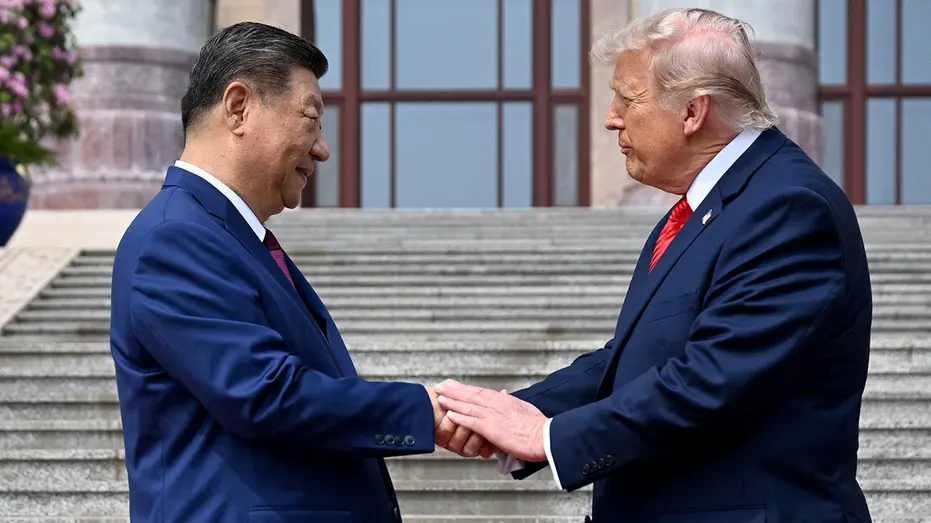
SouthernWorldwide.com – Chinese President Xi Jinping conveyed a stern warning to President Donald Trump, indicating that Taiwan could become a catalyst for “clashes and even conflicts” between the two global powers. This statement introduced a potential for confrontation during an otherwise positive summit held in Beijing.
According to Chinese Foreign Ministry spokesperson Mao Ning, President Xi emphasized to President Trump that the issue of Taiwan is the most critical element in China-U.S. relations. He stated that if handled correctly, bilateral relations would maintain overall stability. Conversely, improper handling would lead to clashes and potential conflicts, jeopardizing the entire relationship.
In contrast to Xi’s warning, President Trump adopted a notably warm public demeanor. He expressed optimism for a “fantastic future together” and lauded Xi as “a great leader” as the two leaders commenced discussions primarily focused on trade, investment, and economic cooperation.
Trump remarked on the longevity of the relationship between their two countries, stating, “We’ve had a fantastic relationship. We’ve gotten along.”
Senate Minority Leader Chuck Schumer of New York criticized Trump following the meeting, accusing him of failing to respond assertively to Xi’s warning. Schumer stated that Xi had threatened “to collide or even clash” with the United States if support for Taiwan continued, and that Trump apparently remained silent in response.
Schumer urged Trump to safeguard democracy, global economic stability, and the interests of American workers, families, and businesses, emphasizing that Trump “must not sell out Taiwan.”
This exchange highlights how Taiwan, a long-standing sensitive and potentially volatile issue in U.S.-China relations, is resurfacing as a central point of contention, even as both nations aim to project an image of stability and concentrate publicly on trade and economic collaboration.
Analysts had previously cautioned that the most favorable outcome for Taiwan at the summit would be for the issue to remain off the agenda. This concern stemmed from the possibility that Beijing might attempt to leverage the situation for concessions or to influence U.S. policy statements behind closed doors.
Prior to the summit, Trump himself had suggested that U.S. arms sales to Taiwan might be a topic of discussion with Xi. He had informed reporters earlier in the week that he intended to have that discussion with President Xi.
This prospect caused alarm among some national security analysts, who advised against allowing Taiwan to become a bargaining chip in broader U.S.-China negotiations concerning trade or other strategic matters.
“Taiwan needs to stay off the menu,” stated retired Rear Adm. Mark Montgomery of the Foundation for Defense of Democracies during a media briefing before the summit. He elaborated that having Taiwan on the agenda for foreign military sales would be detrimental, and any discussion about reimagining U.S. policy statements regarding Taiwan would be even worse.
Experts believe that even minor alterations in wording could have significant repercussions. For instance, a shift from the established U.S. policy of “not supporting” Taiwan’s independence to language stating it “opposes” it could be exploited by Beijing to strengthen its claims over the self-governing island.
For decades, U.S. policy has maintained a delicate balance. It formally acknowledges Beijing as the government of China under the “One China” policy while simultaneously nurturing unofficial relations with Taiwan and supplying it with defensive weaponry as stipulated by the Taiwan Relations Act. Washington has also deliberately maintained an ambiguous stance on its military response, a strategy known as “strategic ambiguity,” designed to deter both a Chinese invasion and a unilateral declaration of independence by Taiwan.
Following the summit, however, Secretary of State Marco Rubio attempted to downplay the significance of the Taiwan discussions. He asserted that U.S. arms sales to Taiwan “did not feature prominently” in the talks and reiterated that long-standing U.S. policy remained unchanged.
Liu, referring to the Democratic Progressive Party (DPP) authorities in Taiwan, stated that their “obstinate pursuit of their separatist agenda is the root cause undermining peace and stability across the Taiwan Strait.”
Despite the underlying tensions surrounding Taiwan, the public discourse at the summit remained cordial, with both leaders emphasizing the importance of cooperation and economic ties.
Xi conveyed to Trump that “China and the United States both stand to gain from cooperation and lose from confrontation,” adding that the two nations “should be partners, not rivals.”
Read more : Why U.S. CEOs Are in China with Trump and Their Objectives
President Trump arrived in Beijing accompanied by a delegation of prominent American business leaders, including Apple CEO Tim Cook, BlackRock CEO Larry Fink, Tesla and SpaceX CEO Elon Musk, and Boeing CEO Kelly Ortberg. This delegation underscored the administration’s focus on trade and investment, even as geopolitical tensions persisted beneath the surface.