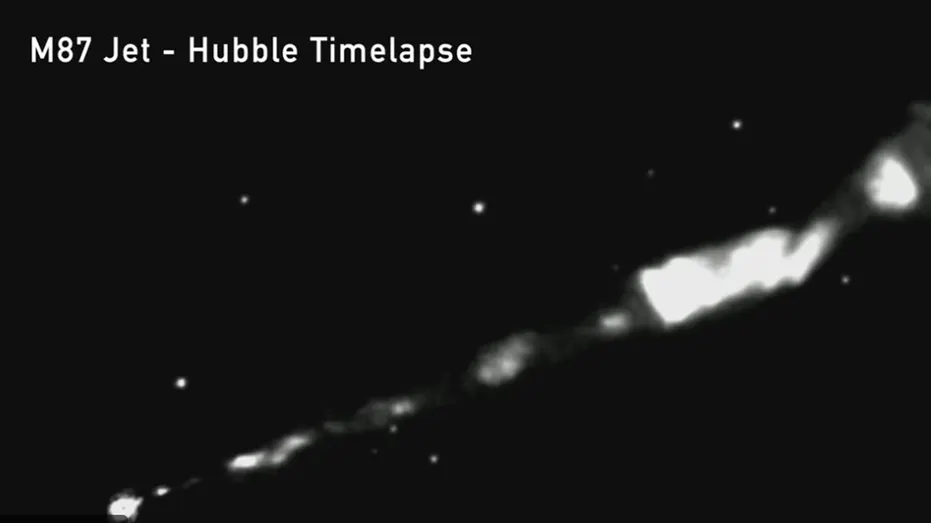
SouthernWorldwide.com – In a significant breakthrough for astrophysics, researchers have successfully pinpointed the origin of a colossal jet stream, stretching an astonishing 3,000 light-years, emanating from the very first black hole ever to be imaged.
This remarkable achievement was made possible by leveraging the “significantly enhanced coverage” provided by the global Event Horizon Telescope network, as detailed in a new study released this week.
The findings, which were formally published in the esteemed journal “Astronomy & Astrophysics” on Wednesday, hold the potential to illuminate the precise mechanisms and locations from which black holes propel immense cosmic jets that travel at speeds approaching that of light.
The black hole in question is known as M87. It is a supermassive entity situated within the Messier 87 Galaxy, approximately 55 million light-years away from Earth. Its sheer scale is staggering, boasting a mass equivalent to 6.5 billion times that of our sun.
The groundbreaking first image of M87 was unveiled to the public in 2019. This iconic image was the result of data meticulously collected by the Event Horizon Telescope back in 2017.
Dr. Padi Boyd of NASA, in a video discussing the black hole’s discovery, highlighted M87’s dual nature. Not only is it a supermassive black hole, but it is also actively “on.”
She explained that only a small fraction of black holes are active at any given moment, raising questions about their cyclical behavior. The presence of extremely strong magnetic fields is understood to be crucial for launching these jets.
Therefore, this latest image provides direct observational evidence supporting the long-held theory that these powerful jets are indeed being launched from a source connected to the supermassive black hole at the heart of M87.
According to publications like Scientific American and Space.com, M87 exhibits a dual behavior: it not only draws in surrounding gas and dust but also expels powerful streams of charged particles from its poles, which collectively form the observed jet stream.
Saurabh, the team leader at the Max Planck Institute for Radio Astronomy, stated that this study represents a foundational step in bridging theoretical concepts of jet launching with tangible observational data.
He further elaborated that identifying the precise origin of the jet and its connection to the black hole’s “shadow” is a crucial piece of the puzzle. This understanding contributes significantly to unraveling how the central engine of such phenomena operates.
The Event Horizon Telescope is not a single instrument but rather a sophisticated global network comprising eight radio observatories. These observatories work in concert to detect radio waves from celestial objects like galaxies and black holes.
By synchronizing these observatories, the network effectively creates a virtual telescope with a diameter comparable to that of the Earth, enabling unprecedented resolution.
The term “Event Horizon” itself refers to the boundary surrounding a black hole. This is the point of no return, beyond which not even light can escape its immense gravitational pull, as defined by the National Science Foundation.
The current study’s conclusions are based on data gathered by the Event Horizon Telescope in 2021. However, the study’s authors acknowledge that while their results are robust under the performed assumptions and tests, definitive confirmation and more precise measurements will necessitate future observations.
Read more : Robots Work Around the Clock in Package Testing
These future EHT observations are expected to possess higher sensitivity and improved intermediate-baseline coverage, potentially through the addition of more stations and an expanded frequency range.