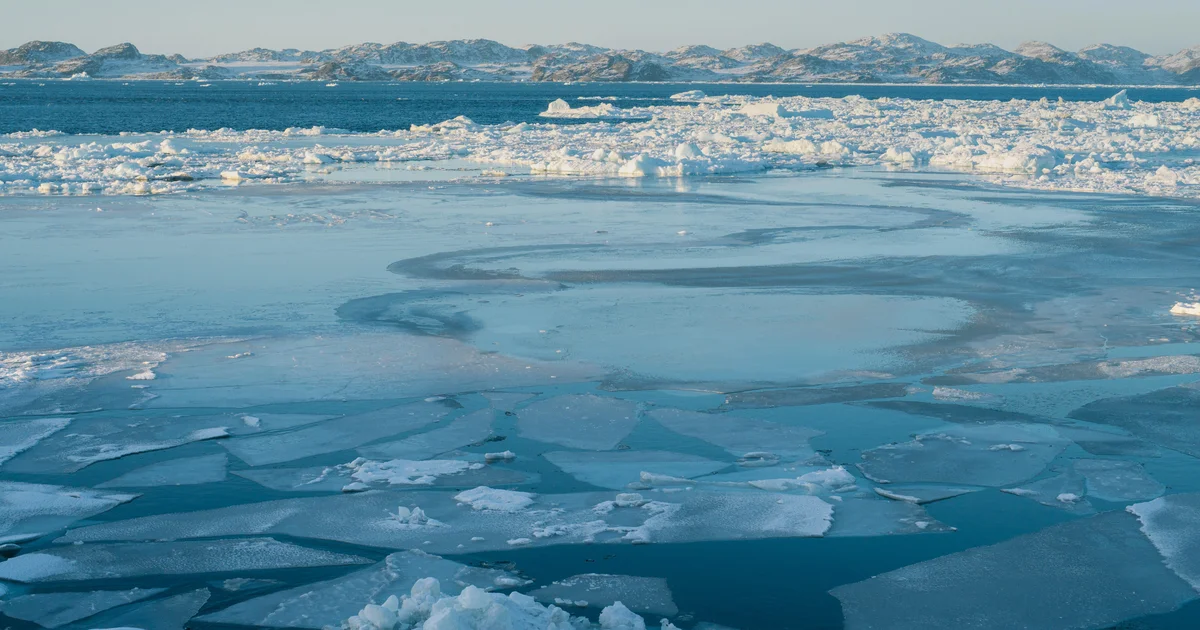
SouthernWorldwide.com – Arctic sea ice has reached a record low for the winter season, nearing its lowest measured point as the planet experiences widespread shattering of heat records.
The extent of Arctic sea ice, particularly during the summer months, plays a crucial role in regulating Earth’s climate. When sea ice diminishes, less sunlight is reflected, leading to increased heat absorption by the oceans. This polar ice acts as a global refrigerator.
The reduction in Arctic sea ice is not only impacting the climate but also opening up new shipping routes. This development is creating geopolitical shifts, making previously overlooked regions like Greenland more strategically important.
NASA has indicated that the shrinking Arctic sea ice “continues a downward trend scientists have observed over the last several decades.” This observation highlights a consistent pattern of decline in the region.
The announcement of the record-low winter sea ice coincided with a wave of record-breaking March temperatures across various continents. These included widespread heat records in the United States, Mexico, Australia, Northern Africa, and parts of Northern Europe.
Climatologist Maximiliano Herrera described the March heat as “by far the most extreme heat event in world climatic history.” He further warned on social media that the extreme temperatures were expected to worsen in the following days.
In the United States, sixteen states reportedly broke their March temperature records within the past week. Meteorologists also noted that twenty-seven locations experienced temperatures high enough to match or exceed the hottest April day on record.
Mexico has seen thousands of its records broken, with some temperatures surpassing those typically seen in May. However, these events are overshadowed by the situation in Asia, where Herrera stated that “dozens of thousands of monthly records” were broken by significant margins.
Read more : Book Excerpt: Mel Robbins' "The Let Them Theory
Despite the widespread heat, Antarctica recorded its coldest March day on record earlier in the week. Temperatures there plummeted to minus 105.5 degrees Fahrenheit (minus 76.4 degrees Celsius), according to Herrera and weather historian Christ Burt.
Steady decline of sea ice
Each year, Arctic sea ice expands during the cold winter months and retreats during the summer heat. This year, the ice growth was notably limited, with its peak extent before the shrinking season measuring 5.52 million square miles (14.29 million square kilometers).
This figure is marginally smaller than last year’s peak of 5.53 million square miles (14.31 million square kilometers). The National Snow and Ice Data Center (NSIDC), which monitors these measurements, considers these two figures to be effectively tied.
NSIDC senior research scientist Walt Meier stated that this “record low maximum gives a head start to the spring and summer melt season.” This suggests that the reduced ice cover at the start of the melt season could lead to more significant ice loss.
Samantha Burgess of the European Centre for Medium-Range Weather Forecasts (ECMWF) shared a similar outlook, suggesting that this could trigger a “potentially faster and more extensive summer melt.”
The sea ice area this year was approximately 525,000 square miles (1.36 million square kilometers) below the 1981-2010 winter average peak. This deficit is equivalent to roughly twice the size of Texas.
“As temperatures have warmed and are continuing to warm, especially in the polar region, there is less opportunity to grow ice and it’s gonna tend to, on average, be less,” Meier explained. He clarified that this trend represents a “steady decline in the winter and at the maximum,” rather than a sudden regime shift.
Sea ice is a critical habitat for various wildlife, including polar bears, penguins, and seals. Recent analyses of satellite imagery have shown emperor penguins being forced into crowded conditions due to the rapid disappearance of sea ice during their molting season.
Scientists warn that meaningful climate cooling is essential for the long-term survival of these species, as the loss of sea ice directly impacts their ability to thrive.
Summer sea ice is key
Meier emphasized that the summer melt season, which culminates in the Arctic sea ice minimum measured in September, is “really the critical time.” A primary reason for this is that reduced white ice cover means the oceans absorb more heat from the strong summer sun.
This increased ocean heat absorption can lead to Arctic warming that approaches temperatures further south. It can also alter atmospheric pressure patterns, potentially influencing the jet stream’s behavior.
One leading, though still debated, theory suggests that these Arctic changes can affect the jet stream’s movement and shape, contributing to extreme weather events. It is important to note that melting sea ice does not directly contribute to sea level rise.
The winter sea ice growth season is more susceptible to variations due to weather patterns. Therefore, a record-low winter maximum in March does not automatically guarantee a record-low summer extent.
“The winter maximum is certainly interesting,” Meier commented. “It is, I’d say, a climate change global warming signal.”
In contrast, Antarctic sea ice is significantly influenced by local weather and oceanographic conditions. While Antarctica reached its annual low point in February, and its extent was smaller than the 30-year average, it was not close to the record lows observed in the past three years.
Agence France-Presse contributed to this report.