SouthernWorldwide.com – The Congressional baseball game, a cherished tradition dating back to 1909, presents a unique challenge for broadcasters due to its unconventional numbering system.
The Republican team’s roster featured a perplexing array of duplicate numbers: two 1s, three 3s, three 4s, one 04, three 6s, two 06s, two 7s, two 07s, two 9s, and three 12s.
This was not a cryptic computer code, a bank account routing number, or hexadecimal communication. Instead, these numbers were the uniform identifiers for the GOP players in the annual Congressional baseball game held at Nats Park.
The game pits Congressional Republicans against Democrats, a custom that has endured for over a century. Unlike most athletic teams where each player has a unique number, lawmakers in Congress are permitted to select any number they desire for their uniforms.
On the Republican side, House Majority Leader Steve Scalise (R-LA) and Rep. Brad Finstad (R-MN) both wore the number one. Similarly, Reps. Chuck Flesichmann (R-TN), Greg Murphy (R-NC), and Marlin Stutzman (R-IN) all sported the number three.
The Democratic team’s numbering scheme was not significantly less confusing. Four Democrats shared duplicate numbers: two 3s, two 11s, two 15s, and two 25s. For instance, Reps. Morgan McGarvey, D-Ky., and Tom Suozzi, D-N.Y., both wore number three, while Sen. Ruben Gallego, D-Ariz., and Frank Mrvan, D-Ind., chose number 11.
While the game serves as a significant charity event, raising over $3.2 million and attracting 32,000 fans, the numbering confusion becomes a notable issue when the game is broadcast nationally.
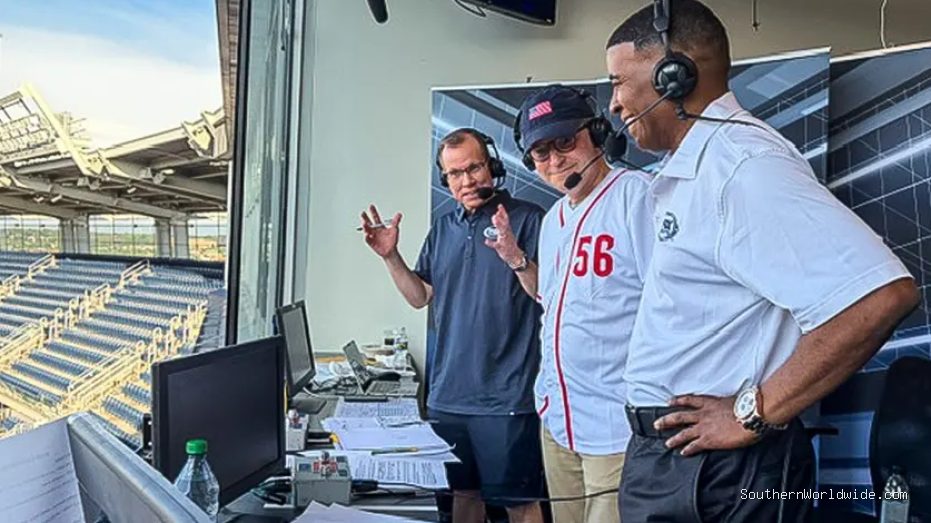
For a seasoned journalist with expertise in both Congress and baseball, calling the Congressional baseball game is an annual professional hurdle. The author recounts personal baseball experiences, such as witnessing Pete Rose break Ty Cobb’s hit record and recalling specific moments from baseball history, highlighting a deep understanding of the sport.
However, the task of deciphering the Congressional baseball game’s player identities and narratives proves more challenging than broadcasting a Major League Baseball (MLB) game. In MLB, broadcasters have access to extensive team information, player statistics, and team performance data, allowing for informed commentary.
The author draws a parallel to Pete Rose’s assertion that the Big Leagues offer the easiest hitting environment due to superior pitching, umpiring, and lighting. In contrast, the Congressional baseball game presents a vastly different landscape, where player statistics are limited, and commentary often relies more on voting records than batting averages.
To prepare for the game, like any reporter, the author diligently researches the lawmakers involved. This preparation is crucial for providing insightful commentary during the broadcast.
The article recounts a specific instance where Sen. Eric Schmitt of Missouri, known for his high OPS in Congressional baseball history and a dedicated St. Louis Cardinals fan, made a spectacular diving catch. This play, despite Schmitt sustaining a facial injury from crashing into the warning track, has become a memorable moment for the game’s lore.
Other notable defensive plays were also made by Reps. Pete Aguilar, D-Calif., and Jimmy Panetta, D-Calif., who executed impressive catches in left field.
The managerial roles also add to the game’s narrative. Rep. Roger Williams, R-Texas, manages the Republican team and has a background as a former Atlanta Braves farmhand. On the Democratic side, Rep. Linda Sanchez, D-Calif., leads the team, still seeking her first win as skipper after five seasons.
The article touches upon the personal baseball allegiances of lawmakers, with Rep. Sanchez recalling her childhood support for the Los Angeles Angels and her admiration for Nolan Ryan, later becoming a Dodgers fan during the era of Fernando Valenzuela.
Two historical anecdotes highlight significant connections between lawmakers and Major League Baseball. Rep. Ray Cannon, D-Wis., in the 1930s, represented players involved in the Black Sox scandal, including Shoeless Joe Jackson.
Another notable figure was Rep. Jacob Ruppert, D-N.Y., who, in the late 19th and early 20th centuries, not only represented New York City but also went on to purchase the New York Yankees. His acquisition of Babe Ruth from the Boston Red Sox transformed the Yankees into a legendary franchise and established Ruth as baseball’s first American superstar.
To facilitate participation in the game, House Majority Leader Steve Scalise strategically scheduled final votes for the day around 4:30 p.m. ET, also instructing committees to suspend votes until after the ballgame. This ensured maximum attendance from lawmakers.
Even with meticulous preparation, unexpected situations arise. The author describes the confusion of seeing freshman Rep. Christian Menefee, D-Texas, pinch-running at first base, a player who did not appear on any provided roster and for whom no information was available.
Menefee’s recent primary victory and subsequent entry into Congress explained his presence, but his lack of prior inclusion on rosters added another layer of complexity to the broadcasting task.
The article concludes by emphasizing that despite all efforts to prepare, the Congressional baseball game, with its multitude of unique circumstances, can still leave one feeling outnumbered and challenged.