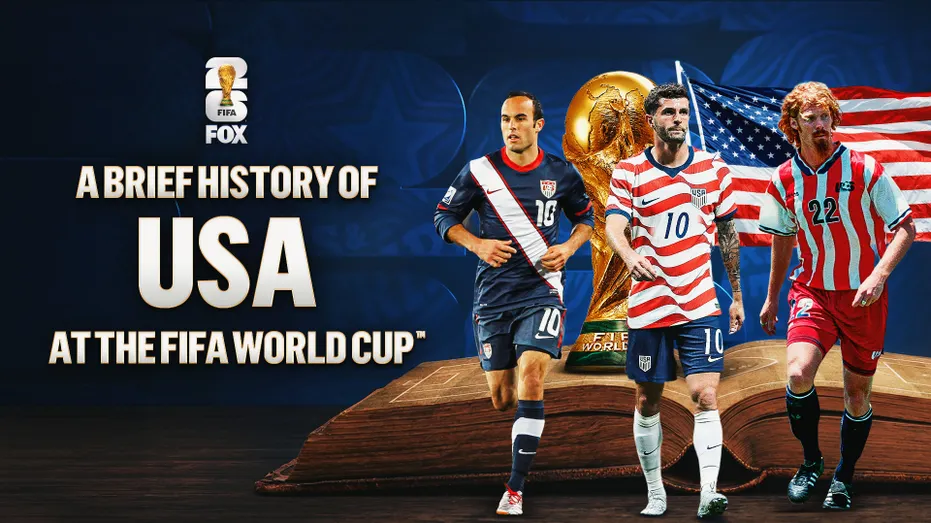
SouthernWorldwide.com – The United States men’s national team is gearing up to perform in front of their home crowds as co-hosts of the 2026 FIFA World Cup. This marks a significant milestone in the team’s journey, which began with its first World Cup appearance at the inaugural tournament in 1930. Here’s a look back at the evolution of the U.S. men’s national team.
Although a team representing the U.S. played a Canadian team in 1885, it took several decades for the U.S. men’s national team to be officially recognized. This period included the 1904 Olympics in St. Louis, where two clubs earned silver and bronze medals.
The United States Soccer Federation was established in April 1913. The U.S. men’s team played its first official international match in Stockholm against Sweden in August 1916, securing a 3-2 victory. This game was part of a six-match tour through Sweden and Norway.
In 1930, the United States joined 12 other international football teams for the inaugural World Cup held in Uruguay. The U.S. team’s first World Cup experience surpassed all expectations, as they remarkably finished in third place.
Following a somewhat unenthusiastic qualifying process, with only Mexico and the U.S. entering from North America, the American squad traveled to Uruguay. This team was a unique mix of semi-professional players, British immigrants, and a goalkeeper born in Belgium.
The U.S. stunned Belgium with a 3-0 victory in their opening match. They followed this with a decisive 3-0 win against Paraguay, topping their group. However, in the semifinal, the U.S. faced a formidable Argentina and suffered a 6-1 defeat. Argentina would go on to lose the first-ever final to the host nation, Uruguay, by a score of 3-2.
Although no third-place match was played, FIFA retroactively awarded the U.S. a bronze medal based on their overall tournament record.
The 1950 World Cup witnessed one of the greatest upsets in football history. Fueled by a 37th-minute goal from Joe Gaetjens, the U.S. defeated a heavily favored England squad 1-0 in Belo Horizonte, Brazil. This match became known as “The Miracle Match” and has been the subject of books and even a 2005 film titled “The Game of Their Lives.”
Similar to the 1930 U.S. World Cup team, the 1950 squad comprised part-time players who held various jobs, including a grave digger and a postman. Gaetjens himself, who was not yet a U.S. citizen when selected for the team, worked as a dishwasher in New York. In contrast, England fielded professional players in their World Cup debut.
Despite this historic win, the U.S. failed to advance beyond the first round. Nevertheless, they made a memorable statement that resonated with the nation, before enduring a subsequent 40-year World Cup drought.
For four decades, American soccer remained a minor player as other professional leagues such as MLB, the NBA, the NHL, and the NFL gained prominence. The U.S. did not qualify for a World Cup for nearly forty years and missed several Gold Cup tournaments, which involve teams from the Confederation of North, Central America and Caribbean Association Football (CONCACAF).
The absence of a strong domestic league hampered the U.S. national team’s ability to assemble talented rosters. While college and youth soccer were popular nationwide, few players had the opportunity to play professionally overseas. The establishment of the North American Soccer League (NASL) in 1968 did attract legendary World Cup figures like Franz Beckenbauer, Pelé, and Johan Cruyff to play in the United States, but it had minimal impact on the success of American players. The NASL ultimately folded in 1984.
In a move that generated controversy, FIFA awarded the United States the hosting rights for the World Cup in 1988. This spurred renewed efforts by U.S. Soccer to qualify for the World Cup in 1990, in preparation for the 1994 tournament. The team achieved this goal, ending its 40-year drought by qualifying for the 1990 World Cup hosted by Italy. With a young and inexperienced squad, the U.S. lost all their group stage matches against Czechoslovakia (5-1), Italy (1-0), and Austria (2-1).
The fortunes of American soccer began to change in the 1990s, notably with the hosting of the 1994 World Cup on home soil. Contrary to expectations of empty stadiums in a nation that favored other sports, the reality was far different. Over 3.5 million fans attended matches across the country, a record that still stands for a World Cup.
Led by several veterans from the 1990 squad and emerging talents like Alexi Lalas and Cobi Jones, the USA also delivered on the field, advancing past the group stages for the first time in 64 years. They were ultimately eliminated by the eventual champions, Brazil, with a 1-0 loss in the round of 16. This result demonstrated that the U.S. could compete with the world’s soccer powerhouses.
The 1994 World Cup paved the way for the creation of Major League Soccer two years later. This development expanded the domestic talent pool and established academies for the nation’s youth players.
Following the success of 1994, high expectations were set for the team at the 1998 World Cup in France. However, that squad faltered and was unable to progress beyond the group stage. They lost all three of their group games against Germany, Iran, and Yugoslavia, managing to score only one goal in total, in the match against Iran.
At the 2002 World Cup in South Korea and Japan, the USA experienced a resurgence, achieving their best finish since 1930. The U.S. defeated Portugal 3-2 and drew with South Korea to advance from their group. In the Round of 16, the U.S. secured a significant 2-0 victory over their arch-rivals Mexico, with goals from Brian McBride and Landon Donovan.
This victory set up a quarterfinal clash with the formidable German team. With the U.S. trailing 1-0 in the 50th minute, U.S. defender Gregg Berhalter (who would later become a coach) fired a shot that was saved by goalkeeper Oliver Kahn. The rebound struck the arm of German midfielder Torsten Frings, but to the U.S.’s dismay, no handball was called. Germany advanced, thus eliminating the U.S. from the competition.
Even greater hopes were pinned on the 2006 World Cup squad that traveled to Germany. However, a challenging group that included the Czech Republic, Italy, and Ghana meant the U.S. failed to reach the knockout stages.
The U.S. managed to advance from the group stage at the 2010 World Cup in South Africa, largely due to one of the most pivotal moments in the team’s history. Landon Donovan scored a last-minute goal in the group stage finale against Algeria, securing a place in the Round of 16.
At the 2014 World Cup, the USA once again found itself in a difficult group, facing Ghana, Portugal, and Germany. Despite the tough competition, they reached the knockout rounds. A hard-fought 2-1 loss to Belgium in extra time sealed the team’s fate, even after a heroic performance by goalkeeper Tim Howard, who set a World Cup record for most saves in a single match.
In a significant low point in its history, the U.S. failed to qualify for the 2018 World Cup in Russia, marking the first time since 1986 that the U.S. had not reached the pinnacle of international football. However, with a new generation of players, spearheaded by Christian Pulisic and Weston McKennie, the team returned to the global stage at the 2022 World Cup in Qatar. They once again reached the Round of 16, where they were ultimately defeated by the Netherlands.
With the 2026 World Cup now on the horizon, the U.S. is set to co-host soccer’s premier tournament on home soil, alongside Mexico and Canada. Pulisic and McKennie are among the 13 players from the 2022 World Cup roster who will be returning for the squad.
The United States will compete against three opponents in the group stage, with the aim of making a deep run into the knockout rounds.
Goals: Clint Dempsey and Landon Donovan share the record for most goals, each with 57.
Appearances: Cobi Jones holds the record for most appearances, with 164 matches played between 1992 and 2004.
Coach with the most wins: Bruce Arena achieved 81 wins during his tenures from 1998-2006 and in 2017.
The 2026 FIFA World Cup will take place from June 11 to July 19, 2026. The tournament, spanning three countries, will conclude with the final on July 19 at the New York New Jersey Stadium in East Rutherford, New Jersey. All 104 tournament matches will be broadcast live across FOX (70 matches) and FS1 (34 matches), with every game available for live streaming and on-demand viewing on both the FOX One and the FOX Sports app. A record 40 matches, representing more than a third of the tournament, will be aired in prime time across FOX (21 matches) and FS1 (19 matches).
The opening match on June 11 between Mexico and South Africa (3 p.m. ET) will be streamed for free on Tubi, as will the USA’s opening match against Paraguay on June 12 (9 p.m. ET).