SouthernWorldwide.com – In a reflection on economic history, Alan Greenspan, the former Federal Reserve chair, once discussed the pervasive role of “systematic fear” in shaping economic behavior.
Greenspan, who served under four presidents, passed away on June 22, 2026, at the age of 100. His tenure as Federal Reserve chair, spanning 18 years, provided him with a unique vantage point on the American economy.
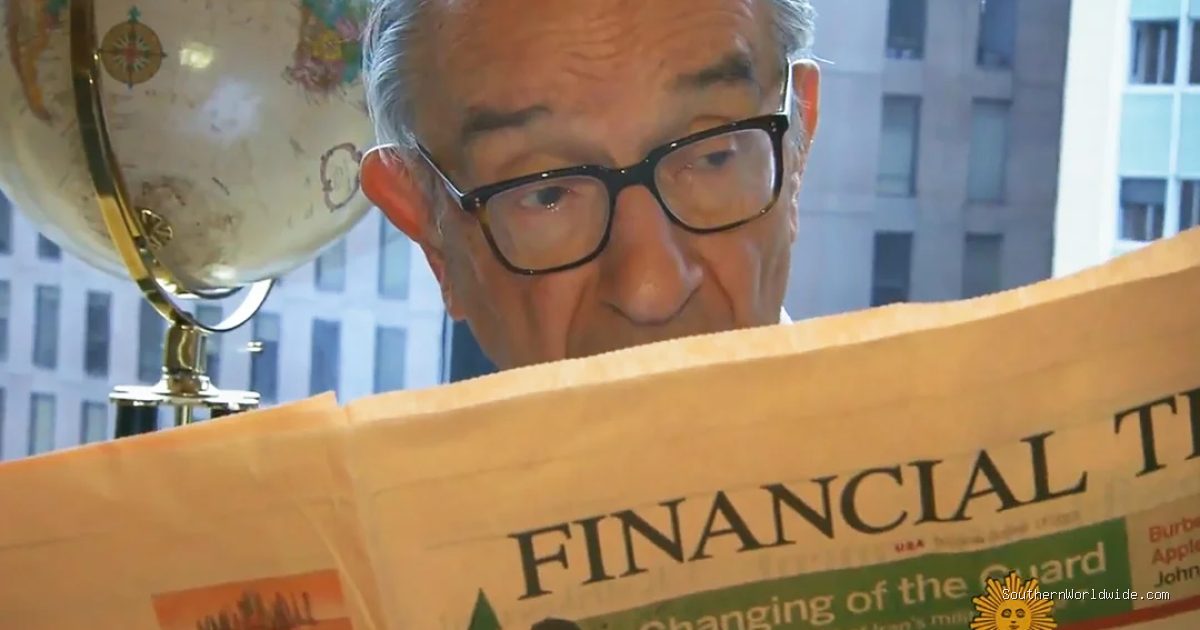
During an interview in October 2013, Greenspan shared insights gained from navigating periods of sustained economic growth that preceded the 2008 financial crisis.
He elaborated on the challenge of quantifying irrational human behavior, a crucial element in predicting market trends. Greenspan believed that the American economic system fundamentally relies on trust.
He famously stated, “You break trust down, and the system implodes.” This underscores his view on the fragility of economic stability when foundational trust erodes.
Greenspan’s wife, NBC journalist Andrea Mitchell, also contributed to the profile, discussing her husband’s dedication to his writing.
The interview delved into Greenspan’s observations on how psychological factors, particularly fear, can systematically influence economic decisions and market dynamics.
He suggested that these systematic fears are not always rational but can become embedded in the collective mindset of investors and consumers.
This phenomenon, he explained, can lead to behaviors that deviate from purely economic logic, creating ripples throughout the financial system.
Greenspan’s insights highlight the intricate connection between human psychology and economic performance.
He emphasized that understanding these psychological undercurrents is as vital as analyzing quantitative data for effective economic management.
The concept of “systematic fear” implies a self-perpetuating cycle where initial anxieties can amplify, leading to widespread economic caution or panic.
This can manifest in reduced investment, decreased consumer spending, and overall economic contraction, even in the absence of fundamental economic weaknesses.
Greenspan’s extensive experience allowed him to witness these patterns repeatedly throughout his career.
He saw how market sentiment could sometimes override underlying economic fundamentals, driven by collective psychological responses.
His perspective suggests that policymakers must consider not only the data but also the prevailing mood and confidence levels within the economy.
The erosion of trust, as he pointed out, is particularly damaging because it undermines the very foundation of transactions and financial agreements.
When trust falters, the efficiency and stability of the economic system are compromised.
This can lead to a breakdown in credit markets and a general reluctance to engage in economic activity.
Greenspan’s reflections serve as a reminder of the complex interplay between human behavior, trust, and economic outcomes.
His insights remain relevant for understanding the psychological dimensions of financial markets and economic policy.
The interview provided a historical perspective on how a key figure in economic policy viewed the impact of fear on the economy.
Greenspan’s legacy is marked by his deep understanding of these often intangible but powerful economic forces.
His contributions continue to inform discussions about economic stability and the management of financial crises.
The “Sunday Morning” profile offered a valuable look into the mind of a man who shaped economic policy for decades.
His emphasis on trust and the impact of systematic fear provides a nuanced view of economic dynamics.
The interview was a testament to his long-standing engagement with the complexities of the American economy.
Greenspan’s passing marked the end of an era in economic leadership.
His reflections on fear and trust continue to resonate in contemporary economic discourse.
The interview serves as a valuable archival piece for understanding economic history.