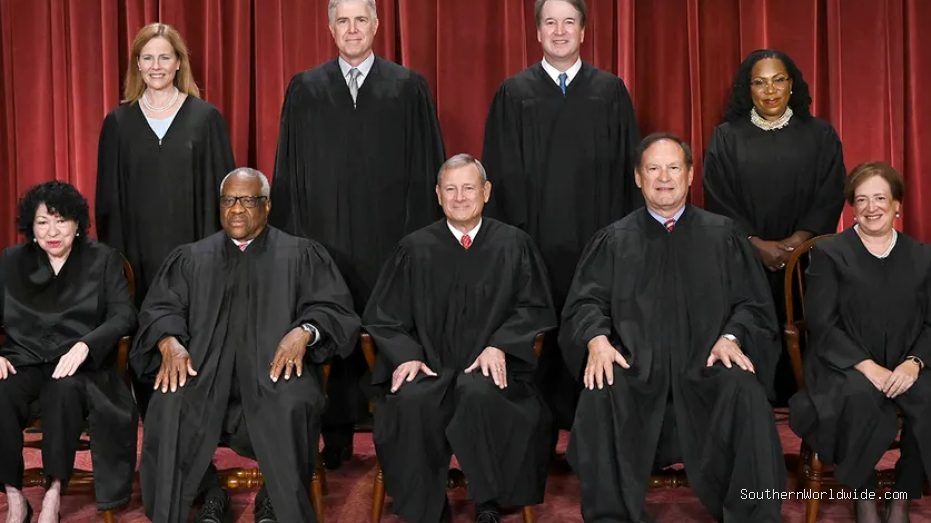
SouthernWorldwide.com – U.S. Supreme Court Justice Samuel Alito has voiced strong concerns regarding the court’s recent decision to permit ballots received after Election Day to be counted, warning that such a policy could erode public trust in the legitimacy of elections.
Alito’s dissent highlighted legal disagreements with the majority’s interpretation of when the “electorate’s choice” is finalized. More critically, he issued a stark practical warning: allowing late-arriving ballots to determine election outcomes long after Election Day is cast could significantly damage the faith Americans place in their electoral system.
“Not only is today’s decision inconsistent with statutory text, legal context, historical practice, and precedent; it also threatens to produce lamentable consequences,” Alito wrote. “The majority’s holding spawns a slurry of troubling election-law questions and risks further undermining Americans’ confidence in election integrity.”
The justice elaborated on a hypothetical scenario to illustrate his point. He described a presidential election where the result hinges on a single state that permits the counting of late mail-in ballots. In this scenario, one candidate might hold a substantial lead on election night, only for the opponent to gradually gain votes and ultimately secure a narrow victory just before the Electoral College is set to vote.
This concern was echoed by Justice Brett Kavanaugh during oral arguments, who noted that if the apparent winner on election night ultimately loses due to late ballots, accusations of a rigged election could “explode.”
Alito went beyond simply suggesting the ruling could affect public perception. He argued that it could create avenues for voter fraud.
“Today’s decision leaves open opportunities for voter fraud that may further undermine Americans’ faith in the integrity of this country’s elections,” Alito stated. “Diverse sources have recognized that mail-in ballots increase the potential for fraud.” He cited a 2005 report by a committee chaired by former President Jimmy Carter and former Secretary of State James Baker, which identified absentee voting as “the largest source of potential voter fraud” in American elections.
While instances of voter fraud involving mail-in ballots have been documented, there is no widespread evidence to suggest such fraud significantly impacted the outcomes of the 2020 or 2024 presidential elections.
Conversely, Democrats advocate for allowing states to process ballots that are postmarked by Election Day but arrive afterward. They argue this is crucial for ensuring that all eligible voters have the opportunity to participate in the democratic process.
Representative Marie Gluesenkamp Perez, D-Wash., expressed relief that the Supreme Court would not interfere with Washington’s mail-in ballot system. She highlighted that for individuals with demanding work schedules, young children, or those living in remote areas, voting by mail is essential for enabling participation in democracy.
The majority of the court, however, did not delve into the policy implications of accepting late ballots. They maintained that such considerations fall outside the court’s purview.
Justice Amy Coney Barrett, writing for the majority, stated, “As we have said time and again, however, policy arguments are properly directed to legislatures, not courts.” The court’s ruling focused on the legal interpretation of existing statutes rather than the broader policy debate surrounding election integrity and voter confidence.