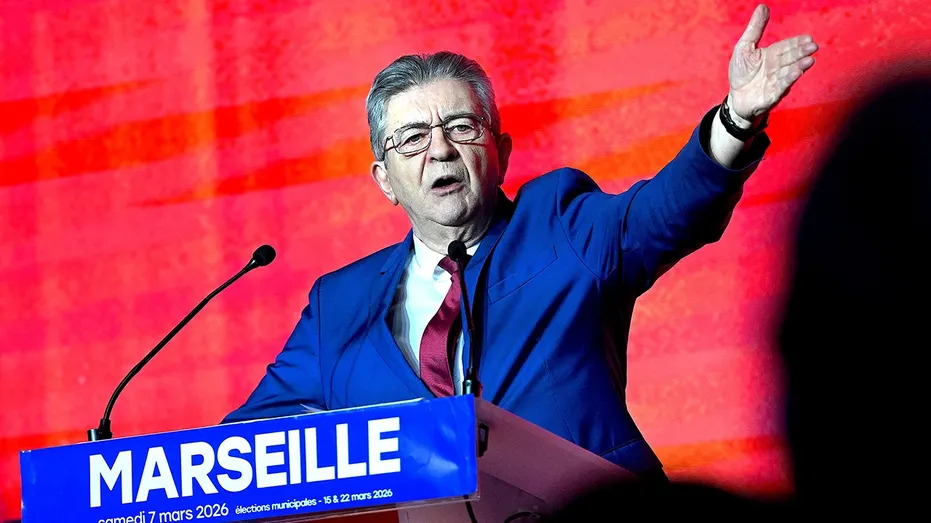
SouthernWorldwide.com – Israel’s ambassador to France has drawn a stark comparison, stating that the rhetoric of France’s far-left leader, Jean-Luc Mélenchon, is reminiscent of Hitler’s. This statement comes amidst a worrying surge in antisemitic incidents across the country, forcing some French Jews to conceal their identity for their own safety.
Ambassador Joshua Zarka highlighted that France, home to Europe’s largest Muslim community and its largest Jewish community, experiences a significant number of daily antisemitic events. He pointed to foreign influences as a key driver behind this escalating problem.
Zarka specifically cited Iran, Russia, Turkey, and Qatar as foreign entities that he believes are exacerbating antisemitism. He also noted that certain domestic political figures in France exploit these sentiments to garner votes, with the far-left party La France Insoumise (LFI) being a primary example.
The ambassador drew a direct parallel between Jean-Luc Mélenchon’s public addresses and the language used by Hitler. He stated, “The way he uses the idea of uniting against one enemy by speaking of Israel is similar to the way Hitler used to speak about the Jews.”
This is not the first time Mélenchon has faced criticism for his remarks. In February, the Human Rights League condemned him for mocking the pronunciation of Jewish names, including that of European Member of Parliament Raphaël Glucksmann.
Mélenchon had previously written on his blog that “antisemitism remains residual in France.” Critics argued that these comments downplayed the severity of the rise in anti-Jewish sentiment following Hamas’s October 7th attacks in Israel.
Zarka also observed a shift in the Jewish community’s perception of the far-right over the past three years. Many no longer view the National Rally, formerly led by Marine Le Pen, as a significant threat in the same way they once did.
He pointed to the National Rally’s president, Jordan Bardella, visiting Yad Vashem and formally committing to combating antisemitism from all political sides. Zarka believes this action has resonated within the Jewish community.
Recent antisemitic incidents include the vandalization of a tree planted in memory of Ilan Halimi, who was a victim of a brutal antisemitic attack in 2006. The tree, located in Lyon, was partially cut down on January 12th.
Further escalating concerns, a young boy wearing a kippah was assaulted on February 9th by a group of five individuals, one of whom reportedly held a knife to his throat. Just ten days later, acid was thrown in two dining areas of a kosher restaurant in Paris.
The pattern of hate continued, with racist and antisemitic graffiti appearing on three high schools in the Montpellier metropolitan area on April 15th.
In March, authorities arrested two brothers in connection with what they described as a “deadly and antisemitic” plot. Police found a semi-automatic weapon, hydrochloric acid, and an ISIS flag in their vehicle.
Rabbi Elie Lemmel recounted being a victim of two antisemitic attacks. In June, he was punched in the stomach in Deauville. Days later, he was attacked again in Neuilly-sur-Seine by an individual from Gaza who struck him with a chair while he was at a café.
Read more : Sleep Doctor Explains the Harsh Health Consequences of Daylight Saving Time
Despite the alarming incidents, Rabbi Lemmel emphasized the importance of not succumbing to fear. “If we start hiding, it is the beginning of the end,” he stated, reaffirming his commitment to wearing his kippah openly.
Yonathan Arfi, president of the Representative Council of Jewish Institutions of France (CRIF), noted that some Jewish families are taking precautions such as removing mezuzahs from their doorposts or using different names on mobile applications to avoid identification.
Arfi urged against allowing fear and withdrawal to be a “trophy” for antisemitic perpetrators. He stressed that Jewish life should continue openly and proudly wherever possible.
The ambassador also indicated that the increasing number of French Jews immigrating to Israel is a concerning sign that some no longer feel secure or see a future for themselves in France.
Historically, French immigration to Israel averaged between 1,500 and 2,000 people annually after the Six-Day War. This figure saw a peak between 2012 and 2015, averaging around 8,000 per year. By 2023, it had dropped to approximately 1,000, but has since risen, with over 2,000 in 2024 and an estimated 3,500 in 2025. The Jewish Agency for Israel anticipates roughly 4,000 immigrants from France in 2026.
Zarka acknowledged that French authorities are actively engaged in combating antisemitism, thus maintaining France as a “relatively safe place.” However, he advised Israelis to exercise caution when traveling to other European countries like Spain, Belgium, and the Netherlands, where he believes antisemitism is more prevalent.
In February, President Emmanuel Macron described antisemitism as an “antisemitic hydra” that had infiltrated “every crack” of French society during a memorial ceremony for Ilan Halimi.
Macron stated that over two decades, despite significant efforts by law enforcement, judiciary, educators, and officials, the “antisemitic hydra has kept advancing.” He elaborated that it constantly assumes new forms and has “insinuated itself into the heart of our societies, into every crevice, too often accompanied by that same pact of cowardice: to keep silent, to refuse to see.”
The French President also condemned “Islamist antisemitism” linked to the October 7th attacks and “far-left antisemitism,” which he suggested rivals that of the far-right.
He further noted that antisemitism increasingly uses “the mask of anti-Zionism to advance quietly.”
Despite these challenges, Zarka revealed that France’s relationship with Israel has faced strains. He disclosed that President Emmanuel Macron’s administration denied requests for U.S. military aircraft carrying weapons to Israel to fly over French territory during the war against Iran.
This marked the second instance of France denying such a request, with the first occurring during the 1973 Yom Kippur War, according to the ambassador.