SouthernWorldwide.com – A routine construction project in Italy has led to an extraordinary archaeological discovery, unearthing the remnants of an ancient sanctuary that dates back to the fifth century B.C.
The find was announced by the Italian Superintendency of Archaeology, Fine Arts and Landscape, bringing to light a significant piece of history in the town of Ponso, located southwest of Venice.
Construction workers, employed by Veneto Strade S.p.A., were in the process of building a new road when they stumbled upon the site. Their initial task involved clearing wartime ordnance, a procedure that unexpectedly led to the discovery of ancient artifacts.
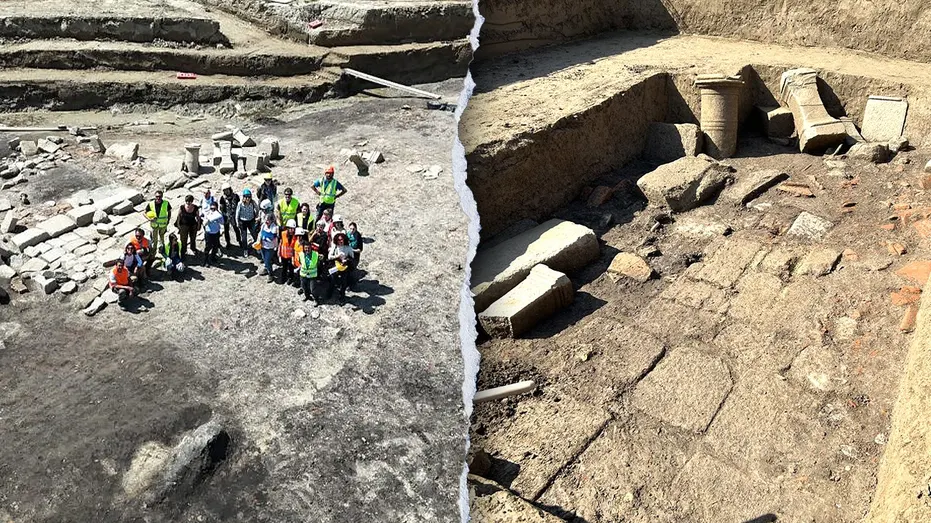
As excavations progressed, archaeologists revealed large, rectangular foundation structures that are believed to have been temples. One of these structures appears to have been distinguished by a surrounding row of columns, hinting at its former grandeur.
The inscriptions found at the site are particularly noteworthy. While some were in Latin, a substantial number were written in the Venetic script. This ancient language was used by the Veneti people in northeastern Italy prior to Roman rule, offering a direct link to a pre-Roman culture.
Read more : Gen Z's Anger is Valid, But Boomers Aren't the True Adversary
Officials stated that many of the inscribed stones seem to have been repurposed within a paved flooring structure, the exact function of which is still under investigation. Some of these stones, however, appear to have remained in their original positions.
Evidence suggests that the paving was constructed around the 1st century A.D. As excavations continued, more large rectangular foundation structures, identifiable as temples, emerged. One of these exhibits characteristics of a peripteral temple, meaning it was encircled by a row of columns on all sides.
Photographs from the excavation site showcase ancient Venetic inscriptions alongside fragments of partially buried columns and stone blocks. These elements are believed to be integral parts of the ancient temple complex.
Some of the inscriptions found at the site possess a “votive character,” strongly indicating their use in religious practices. This further supports the identification of the location as a sanctuary.
Archaeologists theorize that a branch of the Adige River may have caused flooding in the area at some point in antiquity, potentially contributing to the site’s preservation.
Early findings suggest a continuous use and transformation of the site over time, rather than a simple abandonment. This indicates a long-standing significance for the area.
The statement from officials further suggests that the site retained an important function even during Roman times, though its expression and cultural context may have evolved from its earlier phase.
Researchers are actively continuing their investigations, aiming to uncover more details about the sanctuary’s history and purpose.
This discovery adds to a growing list of significant archaeological finds that have been made across Italy in recent times, highlighting the country’s rich historical landscape.
Last year, a remarkable Iron Age necropolis, often referred to as a “city of the dead,” was unearthed in Trento. This site contained burials dating back nearly 3,000 years, offering insights into ancient burial practices.
Earlier in 2026, archaeologists discovered an ancient Roman city situated near the historic Appian Way, a renowned UNESCO World Heritage site. This find underscores the enduring presence of Roman civilization in the Italian peninsula.