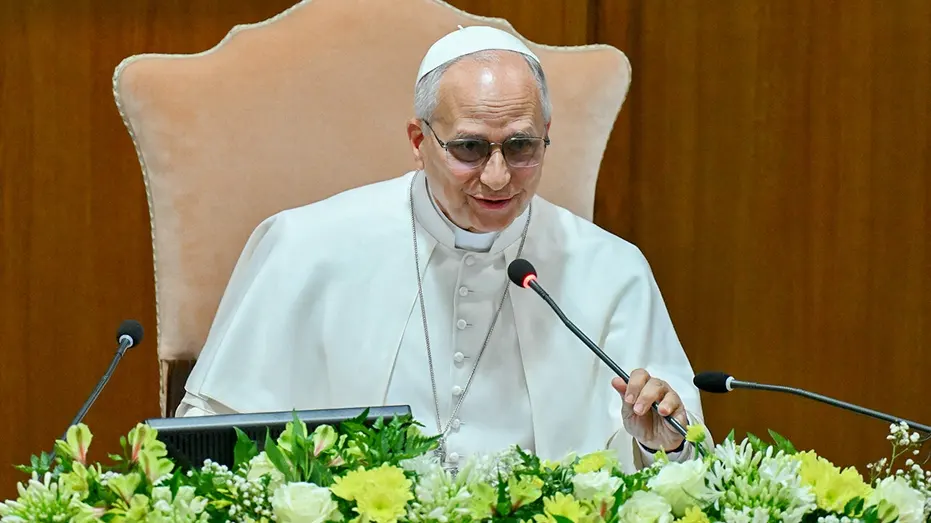
SouthernWorldwide.com – Pope Leo XIV’s encyclical “Magnifica Humanitas” offers a profound examination of the modern world, with a particular focus on the impact of Artificial Intelligence (AI). While the encyclical is already being labeled the “AI encyclical,” Bishop Robert Barron emphasizes that reducing it to this single theme would be a significant oversight, as it delves into much broader and deeper theological and anthropological issues.
The title itself, “Magnifica Humanitas” (Magnificent Humanity), serves as a central framework for understanding the document. Echoing Pope Paul VI’s assertion that the Church is an expert in humanity and Vatican II’s emphasis on the Church’s concern for all dimensions of human experience, Pope Leo highlights the inherent and irreducible nobility of the human being. This dignity, he argues, stems from being made in the image and likeness of God and is further elevated through the Incarnation, allowing humanity to share in divinity.
The encyclical begins by contrasting two Old Testament narratives: the construction of the Tower of Babel and the rebuilding of Jerusalem’s walls. The Tower of Babel, driven by hubris and a disregard for God, resulted in calamity. In contrast, the rebuilding of Jerusalem, guided by Nehemiah, fostered cooperation and was undertaken for God’s glory, leading to a positive outcome. Pope Leo expresses concern that many contemporary advancements, including AI and other technologies, can exhibit a “Tower of Babel quality,” leading to manipulation, domination, and the reduction of communication to a singular digital language.
However, he also believes that these technologies, when used appropriately, can align with a “Nehemiah” framework, serving to enhance human dignity and community. Before delving into the specifics of technology, the Pope first addresses the foundational principles of Catholic social teaching. He stresses the importance of a moral context for considering modern technology, providing a concise overview of the Church’s social doctrine.
This doctrine, he explains, achieves a satisfying ideological equilibrium by balancing seemingly opposing principles. Subsidiarity, favoring local authority, is placed in tension with solidarity, the moral obligation to one another. The dignity of the individual, often emphasized by conservatives, is balanced by a focus on the common good, a tenet typically held by liberals. Similarly, the legitimacy of private property and free markets, important to the right, is considered alongside the universal destination of goods, a concern for the left. This creative tension, according to Pope Leo, is the genius of Catholic social teaching, enabling constructive dialogue across the political spectrum.
POPE LEO XIV CALLS THIS A CHALLENGE TO ‘HUMAN DIGNITY’ IN FIRST ADDRESS TO CARDINALS
In subsequent chapters, Pope Leo addresses the revolution in communication technology. His analysis is shaped by Pope Francis’s concept of the “technocratic paradigm,” which refers to the tendency to prioritize efficiency, control, and practical outcomes over individual dignity and genuine communion. Leo references Romano Guardini, who lamented the dehumanizing aspects of a technologically driven culture in the early 20th century. AI and related technologies are deemed beneficial when they serve as tools for responsible agents pursuing moral ends. They become problematic when they begin to dominate thought and action, bending human nature towards the machine.
The encyclical highlights several key concerns regarding AI. Firstly, Pope Leo expresses deep worry about the pursuit of power over truth in the digital space. He fears that AI can be used to propagate “fake news,” distorted narratives, and misleading information. Drawing on the Tower of Babel analogy, he warns that when will is divorced from reality, disaster follows. He states, “Such power should be constantly guided by the pursuit of truth and respect for human dignity, so that the culture fostered on the internet does not become an instrument of excessive distraction, homogenization or dominance, but rather a setting in which inner freedom and critical thought can mature” (136).
A related concern is how AI might undermine the slow, careful work needed to discover profound truths. The ease with which AI delivers information can mislead people into believing that acquiring data is equivalent to gaining understanding. The Pope observes, “Many educators already report signs of dehumanization, where people may ‘know many things’ but struggle to find direction in their lives, partly due to an inability to connect information with deeper knowledge or maintain a sense of purpose” (146).
Baca juga di sini: Fernando Tatis Jr. Ends Home Run Slump with Powerful Blast
Pope Leo is also troubled by the negative psychological effects of the internet, noting a strong correlation between screen time and depression, anxiety, and low self-esteem. Furthermore, the internet has become a breeding ground for sexual exploitation, grooming, and blackmail, and it provides access to harmful pornography. Consequently, the Pope calls for effective regulation of this potentially hazardous media landscape.
THE AI REVOLUTION THREATENS OFFICE JOBS, BUT REVIVES DEMAND FOR SKILLED TRADES
Another significant concern for the Pope is the impact of AI on the world of work. Following St. John Paul II, Leo views labor not just as a necessity but as a crucial aspect of human flourishing. Through work, individuals engage their minds, wills, and bodies, realizing latent potential. When AI’s speed and efficiency lead to the elimination of jobs, while potentially benefiting the powerful economically, it poses a moral and spiritual crisis for the working class. The encyclical states, “The pursuit of greater profits cannot justify choices that systematically sacrifice jobs, because the human person is an end, not a means, and the economic order must remain subordinate to human dignity and the common good” (152).
Finally, Pope Leo expresses deep anxiety about the addictive nature of social media. He points out that web-accessing devices are intentionally designed to be addictive, a phenomenon evident in the widespread practice of “doomscrolling.” Moreover, because AI tools collect extensive personal data, individuals are highly vulnerable to manipulation by those with malicious economic and political motives. The Pope warns, “When every action — movements, purchases, relationships and preferences — leaves a trace, a new form of power emerges, namely the power to profile, predict and influence behavior, often without individuals being fully aware of it” (171). The fourth chapter of “Magnifica Humanitas” is rich with insights, and individuals and groups are encouraged to engage in a thorough reading of it.
The final chapter of the encyclical shifts focus to issues of war and peace, a section likely to be highly discussed and controversial given current global political tensions. This part of the letter is deeply influenced by St. Augustine’s philosophy, particularly his distinction between Roman society, which worshipped morally ambiguous deities and was characterized by the “lust to dominate” (libido dominandi), and Christian society, which worships the God of love and ought to be marked by forgiveness, peace, and reconciliation.
Pope Leo is distressed by the prevalence of war in the world today and calls for the Church to offer an alternative vision: a civilization of love. He suggests this “City of God” will not arise from grand, top-down plans but from the cumulative efforts of individuals. He quotes J.R.R. Tolkien: “It is not our part to master all the tides of the world, but to do what is in us for the succour of those years wherein we are set, uprooting the evil in the fields that we know, so that those who live after may have clean earth to till” (213). In an era where AI and advanced technologies make warfare more likely and “efficient,” Pope Leo urges the Church to advocate for peace.
An interesting point of reflection arises in the context of war and peace. While St. Augustine is renowned for his theory of just war, Pope Leo finds this theory “outdated.” Bishop Barron clarifies that Augustine’s theory was not a facile justification for war but rather a severe limitation on its practice. The criteria—declaration by a just authority, proportionality, discrimination between combatants and noncombatants, and last resort—remain relevant, though their application needs rigor in today’s context, given the dramatic changes in warfare. The Pope’s statement suggests that a hasty application of these protocols would be naive, but the underlying principles still hold significant weight.
In conclusion, Bishop Barron urges readers to engage with Pope Leo XIV’s encyclical thoughtfully and meditatively, stepping away from the online world of contentious opinions and verbal aggression. He encourages a deeper understanding of the work of this wise man, an expert in humanity, and his profound insights into the challenges and opportunities of our time.