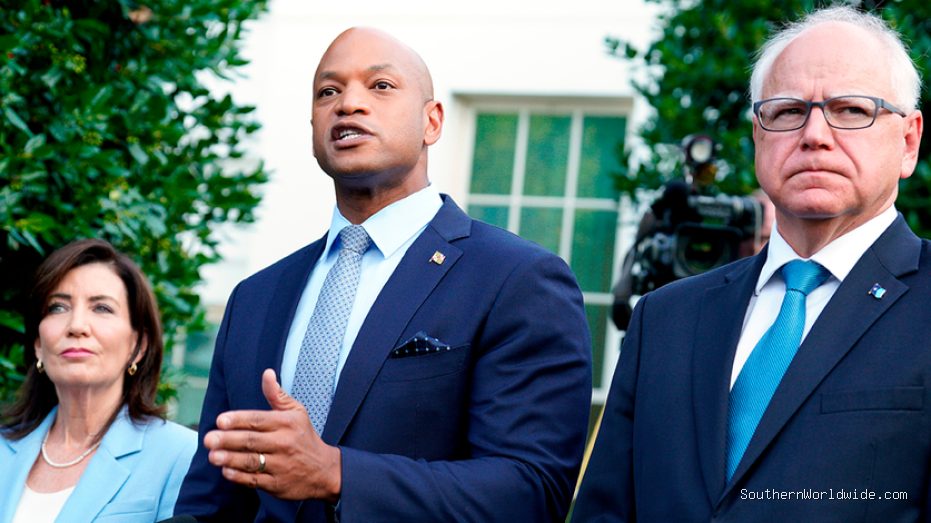
SouthernWorldwide.com – Maryland Democratic Governor Wes Moore is facing sharp criticism for his recent condemnation of “tribal” politics, particularly as his administration is pushing a redistricting plan that opponents argue would eliminate the state’s only Republican congressional seat.
Moore, a prominent figure within the Democratic party and a potential contender for the 2028 presidential election, delivered a speech on Independence Day where he characterized American history as a tapestry of “powerful,” “painful,” and “complex” threads.
Speaking at the Maryland State House, a location steeped in history where George Washington famously resigned his military commission in 1783, Governor Moore articulated his concerns about the current political landscape. He stated, “Too many feel that our politics has become tribal, that our political system once felt like a gift, but the politics of today feel like a grift.”
His remarks have drawn a strong reaction from critics, who point to the ongoing redistricting efforts as a direct contradiction to his anti-tribalism stance. Del. Mark Shoemaker, a Republican, directly addressed this perceived hypocrisy.
“On the basis of what you would have to characterize as tribalism, he is going to convene a special session of the Maryland General Assembly to redistrict Maryland’s only Republican congressman out of office. Sounds like tribalism to me,” Shoemaker stated.
Leaders within the Maryland General Assembly have announced plans to convene a special session commencing on August 3rd. The primary agenda item will be to consider a constitutional amendment concerning congressional redistricting. This session follows sustained pressure from Governor Moore and House Minority Leader Hakeem Jeffries, D-N.Y., on Maryland Democrats to advance a redistricting plan that is widely expected to dismantle the state’s sole Republican-held congressional district.
The push for this redistricting plan has been a significant undertaking. An earlier attempt to pass a similar redistricting bill had stalled, largely due to the opposition of Maryland Senate President Bill Ferguson, a Democrat. Ferguson had deemed the proposed map “objectively unconstitutional” and expressed considerable concern about the potential “catastrophic” downside risk for the Democratic party.
Notably, following the setback of the initial redistricting bill, Governor Moore did not publicly endorse Ferguson in his subsequent primary race, despite Ferguson’s prominent position as one of the state’s highest-ranking Democrats.
In the wake of the announcement for the special session, Governor Moore released a statement emphasizing the urgency of the situation. “For months, I have said that inaction is not an option and we cannot sit on the sidelines while voting rights, fair representation, and the foundations of our democracy come under attack across the country,” he declared.
He further expressed his appreciation for the ongoing dialogue and the agreement to reconvene. “I appreciate the General Assembly’s continued conversations and the agreement to come back to finish the work,” Moore stated, adding, “My administration will work closely with the General Assembly as they consider legislation to ensure our state has the tools necessary to protect voters and defend fair representation.”
Meanwhile, Del. Shoemaker, who has a long history of service in the Maryland House of Delegates, including a stint as minority whip, accused Governor Moore of being overly focused on national political aspirations rather than addressing the pressing concerns of Maryland residents. Shoemaker argued that residents are “fleeing in droves” from the state.
“His record as governor is abysmal,” Shoemaker asserted. “Since he became governor, almost four years ago, all that he’s done is really tried to position himself to run for president.”
Shoemaker also took issue with Governor Moore’s recent critique of American nationalism during his July 4th address. Moore had remarked on the tendency of some to use patriotism to justify actions like removing books from schools and altering historical narratives to suit those in power.
“Today there are those who will use patriotism to justify pulling books from schools and rewriting history until it comforts those in power. In reality, that’s not patriotism; that’s nationalism,” Moore had said. He further elaborated, “Nationalism is not an extension of patriotism; they are not interchangeable. There’s a difference, and that does matter.”
In response, Shoemaker offered his interpretation of the terms. “Patriotism means that you love your country,” he said, contrasting it with his view that “nationalism means that your country is exceptional.”
“It’s pretty clear to me that neither Gov. Moore nor the ultra-progressives generally think that America is exceptional, and I think that’s incredibly sad,” Shoemaker concluded.
The governor’s comments also drew fire from Matt Morgan, Chair of the Maryland Freedom Caucus and a Republican. Morgan criticized Moore’s framing, suggesting it was a rhetorical tactic to demonize dissenters.
“In Moore’s world, if you’re a parent concerned about explicit material in your child’s school library, you’re a nationalist. If you question the revisionist history framework of the 1619 Project and advocate for accurate, honest history, you’re not a patriot. You’re a nationalist,” Morgan stated.
“It’s a neat rhetorical trick: reframe the terms, and suddenly anyone who disagrees with you is the villain,” he added.
Morgan further highlighted what he sees as misplaced priorities. “While Maryland families sit around their kitchen tables wrestling with sky-high taxes, crushing energy costs, and a cost-of-living crisis made far worse by Annapolis Democrats, Governor Wes Moore has decided now is the perfect time to call a special session,” Morgan remarked.
The debate over books in schools has been a contentious issue. In 2025, the Maryland State Board of Education reviewed Carroll County’s decision to remove 20 books from school libraries. Parents had argued that these removals violated the Maryland’s Freedom to Read Act, legislation signed into law by Governor Moore in 2024. Ultimately, the State Board upheld the county’s decision, allowing the books to remain removed from library shelves.
Shoemaker expressed his strong disagreement with the policies related to school libraries and historical interpretation. “Fighting to keep filth in public schools and public school libraries, or, you know, even revising history to make villains of founding fathers who have made our country great by just pointing out their flaws. That seems like moral relativism to me and revisionism at its worst,” he stated.
Shoemaker attributed policies like these, coupled with continuous tax increases, as the driving force behind his decision to relocate out of the state at the conclusion of his current term. He claims that he is not alone in his dissatisfaction with Maryland’s current leadership.
“I’ve talked to a lot of people; most of them say that they don’t blame me a bit for fleeing Maryland, and a substantial number of those folks say that they’re right behind me,” Shoemaker concluded.