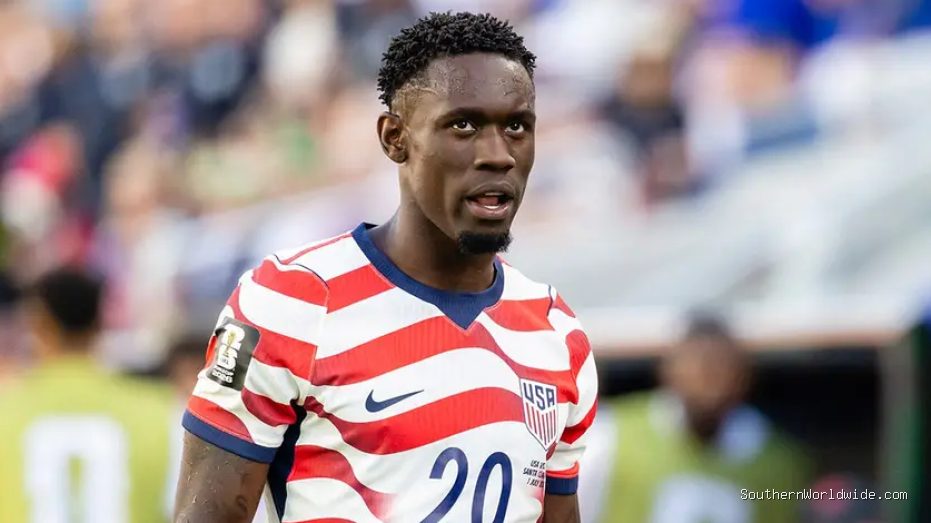
SouthernWorldwide.com – The United States men’s national team secured a significant victory, though it came with a considerable consequence.
During their 2-0 win against Bosnia and Herzegovina on Wednesday night, Folarin Balogun, who had scored in the first half and is the team’s top scorer in this World Cup, received a controversial red card.
While vying for a loose ball, Balogun and an opponent became entangled. Balogun accidentally stepped on the opponent’s ankle, causing it to twist awkwardly. The video assistant referee (VAR) reviewed the incident, and Balogun’s actions were deemed severe enough to warrant a red card.
This red card not only led to Balogun’s ejection from the match, forcing the USA to play the remainder of the game with 10 players, but also means he will miss the team’s Round of 16 match against Belgium on Monday.
The decision immediately sparked widespread criticism, with fans hoping for an appeal. However, such a process is not available.
According to Article 9.6 of the 2026 World Cup regulations, “No protests may be made about the referee’s decisions regarding facts connected with play. Such decisions are final and not subject to appeal, unless otherwise stipulated in the FIFA Disciplinary Code.”
Furthermore, Article 10.5 states, “If a player or team official is sent off as a result of a direct or indirect red card (second caution), they will automatically be suspended from their team’s subsequent match.”
The severity of punishments can escalate. For instance, Qatar midfielder Assim Madibo received a five-game suspension after breaking the leg of Canada’s Ismaël Koné. While unlikely for Balogun, this possibility is not entirely out of the question.
Opinions are divided on whether VAR was applied correctly in this situation. For the United States, the unfortunate reality is that VAR can be used to determine the issuance of a red card. Ultimately, the head referee makes the final decision after reviewing the footage, though they can take input from VAR officials.
The International Football Association Board (IFAB) guidelines suggest avoiding slow-motion replays in VAR, except when determining “facts, e.g. position of offence/player, point of contact for physical offences and handball, ball out of play (including goal/no goal).” Normal speed should be used to assess the “intensity” of an offense or for handball decisions. Balogun’s incident may fall under the “physical offences” category.
The IFAB also defines serious foul play as when “Any player who lunges at an opponent in challenging for the ball from the front, from the side or from behind using one or both legs, with excessive force or endangers the safety of an opponent is guilty of serious foul play.”
Therefore, despite a potential lack of malicious intent from Balogun, the USMNT faces an unfortunate and difficult challenge. The team must now find a replacement for a player who has arguably been their most impactful, in what is now a pivotal match in United States soccer history.
The United States is considered a slight favorite to defeat Belgium on Monday night in Seattle, but their chances have undoubtedly been impacted by Balogun’s suspension.