SouthernWorldwide.com – Two amateur treasure hunters have made a groundbreaking discovery in Norway, unearthing one of the largest Viking coin hoards ever found in the country’s history.
The significant find occurred in a field near Rena, a location situated approximately 18 miles north of Elverum in southeastern Norway. The announcement of this remarkable discovery was made by the University of Oslo’s Museum of Cultural History (KHM).
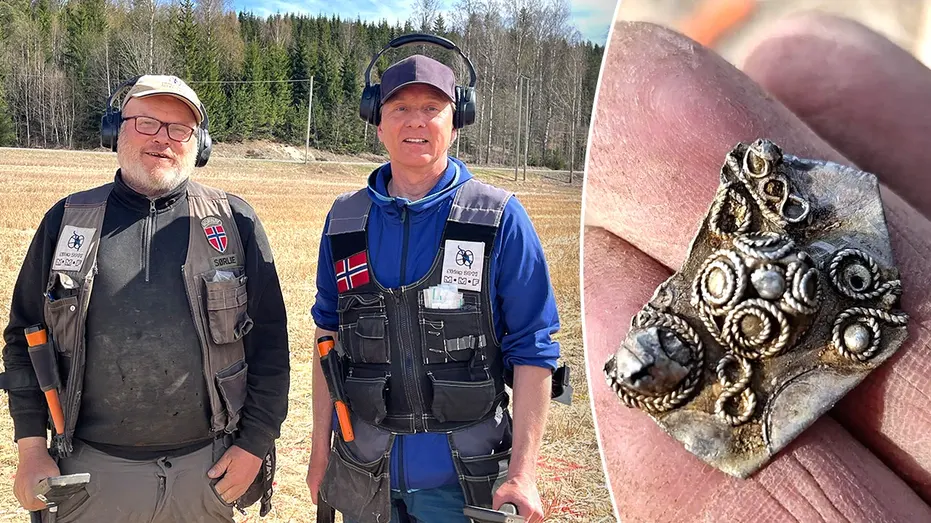
Rune Sætre and Vegard Sørlie, the individuals responsible for the find, initially suspected they had stumbled upon something substantial when they discovered 19 silver coins on April 10th.
Their immediate action was to contact local officials at the Innlandet County Authority. This alert quickly transformed the site into the focal point of a major archaeological investigation.
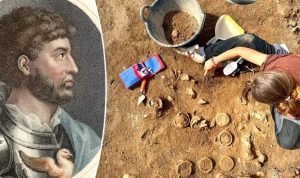
The unearthed cache comprises a staggering 2,970 silver coins, believed to have been buried around the year 1047. This discovery marks the largest Viking Age coin hoard to be found in Norway since 1950, and it is now recognized as the biggest in the nation’s entire history.
The coins themselves date from the period between the 980s and the 1040s. Intriguingly, they bear the names of notable rulers such as Æthelred II, Otto III, Harald Hardrada, and the legendary King Cnut, offering a glimpse into the political landscape of the era.
A significant portion of the coins were minted in England or Germany. Officials interpret this as a clear reflection of the strong foreign economic influence on Norway during the latter part of the Viking Age.
Read more : New York Sheriffs Outraged by Governor's Push to End Law Enforcement Partnership
Professor Svein Gullbekk of KHM elaborated on this point, stating that foreign coinage was prevalent in Norway’s monetary circulation until Harald Hardrada established a national coinage system between 1046 and 1066. The burial of this hoard occurred precisely at the commencement of this transition.
The KHM has characterized the discovery as a “coin hoard without parallel in a Norwegian context,” highlighting its unique significance.
Hanna Geiran, director general of the Directorate for Cultural Heritage, expressed her astonishment, admitting she “could hardly believe her ears” upon hearing about the find.
She further emphasized the importance of the discovery, calling it both a “national and an international event.” Geiran noted that few historical periods capture public imagination as vividly as the Viking Age in Norway.
While the precise reason for the hoard’s burial remains unknown, researchers posit that it may be linked to the region’s thriving iron trade during the Viking Age.
Archaeologist Jostein Bergstøl from the Museum of Cultural History suggests that this substantial coin collection could represent wealth amassed through this very trade.
Bergstøl explained that from the 10th century until the late 13th century, the area experienced immense iron production. Iron ore was extracted from bogs, and the processed iron was subsequently exported to Europe.
Officials also took the opportunity to commend the two hobbyists for their diligent adherence to proper procedures, which greatly assisted in securing the site.
May-Tove Smiseth, an archaeologist with the Innlandet County Authority, described the situation as an “exemplary case of how it should be done.”
She praised Sætre and Sørlie for their prompt communication and for following the Directorate for Cultural Heritage’s guidelines precisely. Smiseth added that they were highly cooperative and actively contributed to the meticulous securing and documentation of the find.
Currently, researchers are engaged in the intricate process of analyzing and registering the coins. The KHM anticipates that this hoard will be a subject of extensive research for many years to come.
This significant Norwegian find joins a growing list of major Viking-era discoveries reported globally in recent times.
For instance, in 2025, archaeologists in northern Germany unearthed a hoard of approximately 1,000-year-old Viking treasures, also alerted by a metal detectorist. Another notable discovery from the same year involved Swedish officials announcing the unearthing of a Viking grave with distinct “Christian overtones” on the outskirts of Linköping.