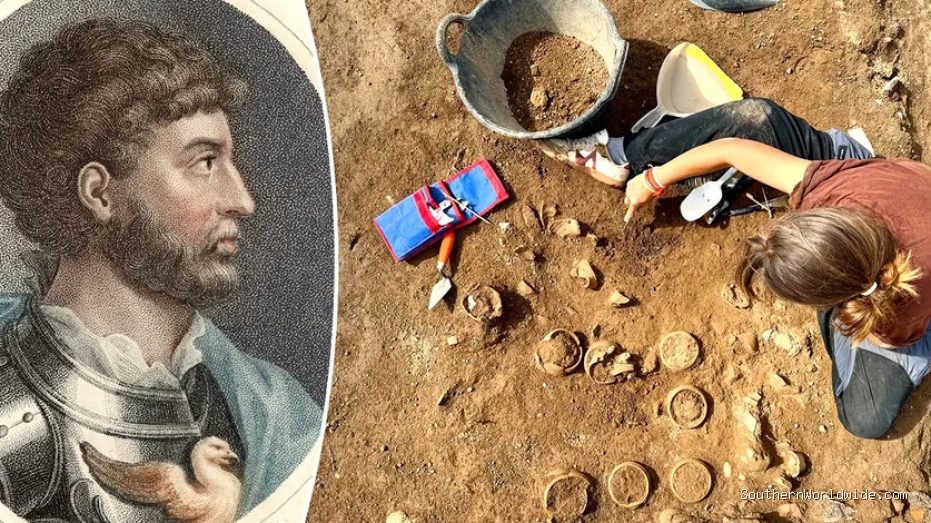
SouthernWorldwide.com – Archaeologists have uncovered a significant underground chamber at Hadrian’s Villa in Tivoli, Italy, believed to be the oldest structure ever found at the site.
The discovery was announced by Pablo de Olavide University (UPO) in Seville, Spain. This imperial villa was once the residence of Emperor Hadrian, who reigned from 117 to 138 A.D. Hadrian is renowned for constructing Hadrian’s Wall in Britain and for his extensive travels across the Roman Empire.
The vast complex is now a UNESCO World Heritage site, attracting numerous visitors and researchers worldwide. The newly found underground structure dates back to the Roman Republic period, which predates Hadrian’s rule by centuries, spanning from 509 B.C. to 27 B.C.
Officials theorize that this abandoned structure might have served as a silo or storage facility. It was found partially filled with debris from ancient construction and ceramic fragments. The find is considered particularly important because it is linked to a villa that existed before Hadrian’s imperial residence and was later integrated into the construction of his palace.
Rafael Hidalgo, director of the Palazzo Project at Hadrian’s Villa, expressed surprise at the structure’s excellent preservation, especially its vaulted roof, which typically deteriorates.
He noted that the roof “was perfectly preserved.” Hidalgo elaborated that “even on the inner surface of the vault, the impressions left by the wooden centering — the timber framework used during construction — are still clearly visible.” These impressions supported the “opus caementicium, or Roman concrete, as it was poured to create the vault.”
The recovery of a substantial collection of archaeological materials from within the structure is expected to provide crucial data for dating the context. Hidalgo stated that this analysis will be vital for establishing the chronology of the earlier villa and determining its period of occupation.
The excavation yielded several ceramic pieces and architectural terracottas that likely adorned the roof of a nearby building. Some of these terracottas featured canine heads, while another depicted a bull’s head.
This discovery is significant as it helps to fill a substantial gap in the understanding of the villa that predated Hadrian’s construction. Hidalgo pointed out that “we have relatively little information about this earlier villa because much of it was destroyed by Emperor Hadrian during the construction of his own complex.”
The find contributes to a growing number of underground archaeological discoveries that offer new insights into ancient Roman life. Earlier this year, the remains of another ancient Roman villa were unveiled beneath a high school gymnasium near Rome’s Colosseum.
Last summer, subway construction for Rome’s Metro Line C led to the discovery of a multi-story apartment building dating back to the first century B.C.