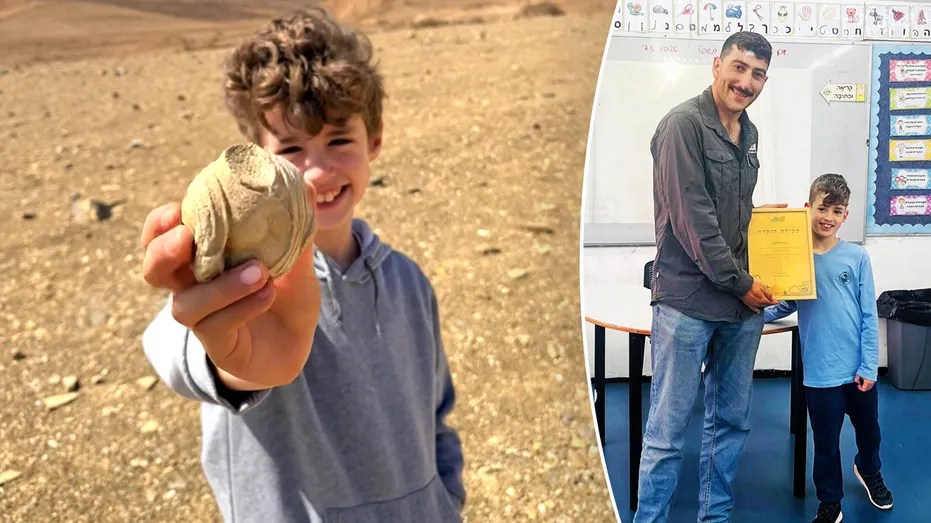
SouthernWorldwide.com – A routine family outing took an extraordinary turn when an 8-year-old boy, Dor Wolynitz, discovered a fragment of a 1,700-year-old Roman statuette while on a trip to the Ramon Crater in Israel’s Negev Desert.
The remarkable find occurred during a weekend retreat organized by a paratrooper reserve unit. Dor was exploring the area, hoping to find something interesting to share with his classmates for show-and-tell.
He recounted his discovery, stating that he was “looking for special things on the ground that I could show in class.” His attention was caught by an unusual stone with stripes, which he picked up.
Recognizing its peculiar nature, Dor showed the object to Akiva Goldenhersh, an archaeologist and a friend of his father who was also present on the trip. Goldenhersh, who supervises the Antiquities Theft Prevention Unit at the Israel Antiquities Authority (IAA), was initially intrigued.
The fragment, measuring six by six centimeters, displays “part of a human figure with carefully sculpted folds of fabric.” Goldenhersh initially mistook it for a fossil.
However, upon closer inspection, the sculpted details of the garment became apparent, sparking significant excitement. The statuette fragment is believed to date back to the fourth century A.D.
Analysis revealed that the statuette was crafted from a local phosphorite-type mineral, native to the Negev region. This suggests that it was likely produced locally, rather than being an imported item.
Read more : Who's In and Who's Out: Shaping the 2026-27 College Basketball Season
Goldenhersh elaborated on the artistic details, noting that the figure appears to be wearing a heavy mantle known as a himation, with no visible undergarment, or chiton. The sophisticated sculpting of the fabric folds and the use of such a delicate material point to the artist’s high level of skill.
The identity of the figure depicted in the statuette remains a subject of speculation. Archaeologists suggest it could represent the Roman god Jupiter or a Nabatean deity known as Zeus-Dushara.
The location of the find, the Ramon Crater area, is historically significant. It lies along the ancient spice route, which served as a crucial trade artery during the Roman and Nabatean periods, facilitating the exchange of goods and cultural influences.
This artifact thus serves as a tangible link to the past, illustrating the blend of indigenous traditions with elements from the classical world. Its discovery as a surface find, rather than through a planned excavation, makes it particularly noteworthy.
Archaeologists theorize that the fragment may have been displaced from its original position over time due to natural processes such as erosion or geological shifts. However, the arid desert conditions of the Negev are also known to be conducive to preserving artifacts and can, at times, expose them on the surface.
In a commendable act of civic responsibility, Dor Wolynitz handed over his remarkable discovery to Israel’s National Treasures Department. In recognition of his actions, he was presented with a certificate for his “good citizenship.”
Goldenhersh praised Dor and his family, stating that their responsible conduct exemplifies proper civic duty and the importance of preserving the nation’s cultural heritage. He concluded by calling Dor a role model for everyone.