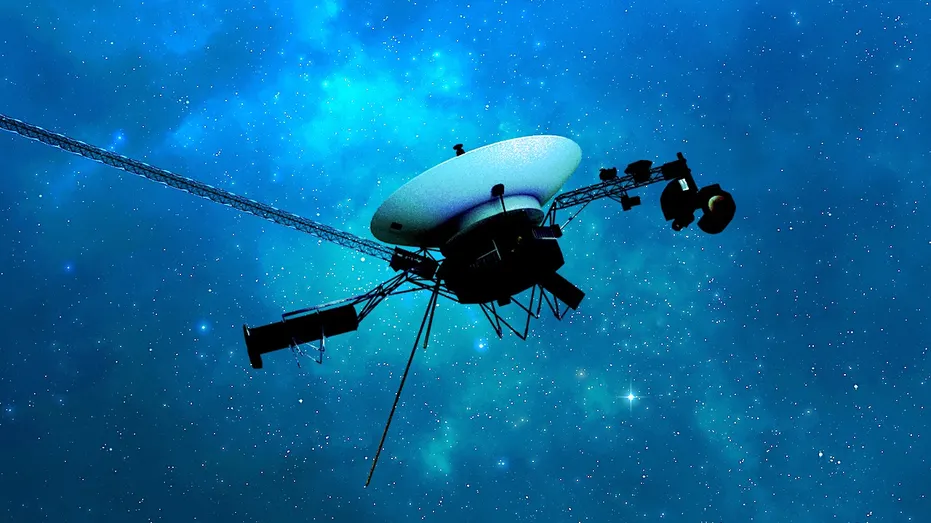
SouthernWorldwide.com – NASA has made the difficult decision to temporarily deactivate one of the science instruments aboard the Voyager 1 spacecraft. This measure is being implemented to conserve its diminishing power supply, ensuring the nearly 49-year-old probe can continue its groundbreaking mission in interstellar space, a remarkable 15 billion miles away from Earth.
Engineers at NASA’s Jet Propulsion Laboratory (JPL) in Southern California issued commands on Friday to power down the Low-Energy Charged Particles (LECP) experiment. This instrument has been a stalwart, operating almost continuously since Voyager 1’s launch in 1977.
The decision reflects the ongoing challenge of managing the power generated by the spacecraft’s nuclear-powered radioisotope thermoelectric generators. These generators are gradually losing about 4 watts of power each year, prompting mission managers to strategize ways to extend the probe’s operational lifespan.
Kareem Badaruddin, Voyager mission manager at JPL, explained the rationale behind the shutdown. “While shutting down a science instrument is not anybody’s preference, it is the best option available,” he stated. He further elaborated that Voyager 1 still has two active science instruments. These are a plasma wave sensor and a magnetic field measuring device, both of which continue to function exceptionally well, transmitting valuable data from a region of space previously unexplored by any human-made craft.
This recent action highlights the increasingly complex balancing act faced by the Voyager team. Both spacecraft have long surpassed their original mission durations, pushing the limits of their aging technology.
Voyager 1 and its twin, Voyager 2, are powered by radioisotope thermoelectric generators. These devices convert the heat generated by decaying plutonium into electricity. After nearly five decades in the harsh environment of space, engineers have been systematically powering down heaters and non-essential instruments. This is a critical step to prevent the spacecraft from becoming too cold, which could jeopardize vital systems like fuel lines.
“The team remains focused on keeping both Voyagers going for as long as possible,” Badaruddin added, underscoring the dedication of the mission personnel.
The urgency to implement power-saving measures intensified following an unexpected power drop experienced by Voyager 1 during a routine roll maneuver on February 27. NASA reported this anomaly, which raised concerns among the engineering team.
Engineers were worried that any further power decline could trigger the spacecraft’s undervoltage fault protection system. This system is designed to automatically shut down components to safeguard the probe. Recovering from such an automatic shutdown can be a time-consuming process and carries inherent risks. Therefore, the team opted for a proactive shutdown to prevent the spacecraft from initiating it autonomously.
The two Voyager probes hold a unique position in space exploration. They are the only spacecraft that have ventured far enough from Earth to gather data on the “detecting pressure fronts and regions of varying particle density in the space beyond our heliosphere,” as stated by NASA.
A NASA press release indicated that engineers are confident that deactivating the LECP will provide Voyager 1 with approximately one year of extended operational time. During this period, they are finalizing a more comprehensive energy-saving strategy for both Voyagers, which they have nicknamed “the Big Bang.” This initiative is designed to further prolong the operational life of the spacecraft.
The “Big Bang” concept involves a simultaneous shutdown of a group of power-consuming devices. This allows for the replacement of some components with lower-power alternatives, thereby maintaining sufficient warmth to keep the spacecraft’s scientific instruments operational and continue gathering data.
The decision to turn off the LECP was not an impulsive one. NASA confirmed that mission science and engineering teams had collaboratively established a prioritized list for shutting down spacecraft systems years ago, anticipating the gradual decline in available power. Out of the 10 original instrument sets carried by the twin probes, seven have now been powered down. Notably, Voyager 2’s LECP instrument was deactivated in March 2025.
Read more : Cabless Electric Trucks Debut in Ohio
Given that Voyager 1 is currently over 15 billion miles from Earth, commands sent from Earth take approximately 23 hours to reach the spacecraft. The entire shutdown sequence for the LECP instrument itself required more than three hours to complete. A small portion of the LECP system, specifically a low-power motor that rotates the sensor for comprehensive scanning, will remain active. This motor consumes only about half a watt. Engineers are hopeful that this could potentially allow for the instrument’s reactivation in the future, should additional power become available.