SouthernWorldwide.com – Poland, a key NATO ally, has issued a stark warning, suggesting that Russia and Belarus are orchestrating a campaign of illegal migration towards the alliance’s eastern flank, with implications extending even to the United States.
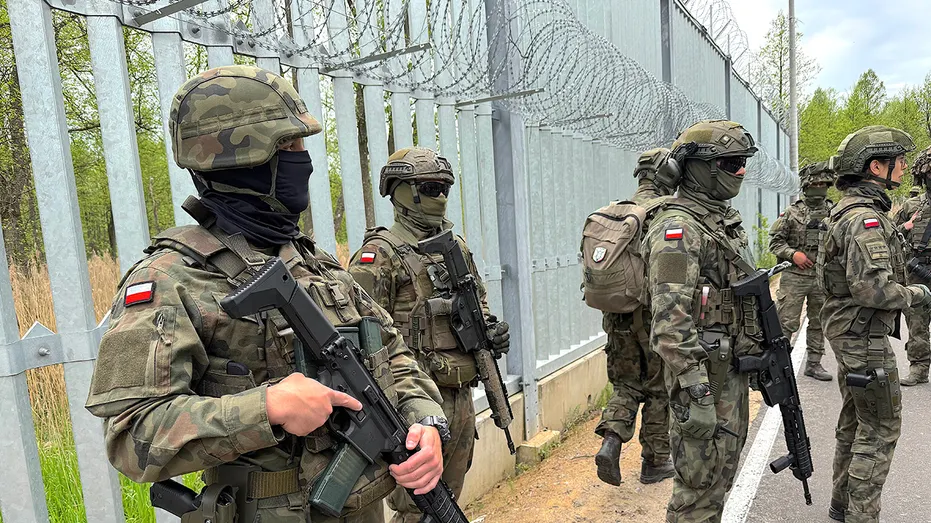
Soldiers from Poland’s 18th “Iron Division” patrol the 521-kilometer border with Belarus, pointing to dense forests where they describe a new form of warfare unfolding. Polish officials are concerned that illegal migrants, allegedly weaponized by Russia and Belarus, are being used to destabilize NATO’s eastern flank and pose a threat to American security.
The border, once primarily managed by the Border Guard and police, has seen the army deployed due to the escalating scale and danger of illegal crossings. Polish authorities now view it not as a conventional immigration challenge, but as a security threat.
The frontier is now defended in multiple layers, involving soldiers, border guards, and rapid-response forces. A temporary barrier erected in 2021 has been enhanced with an electronic fence, surveillance systems, and military patrols. Migrants attempting to cross have reportedly come from countries such as Syria, Somalia, Afghanistan, and India.
Polish officials characterize the situation as “artificial migration,” alleging that individuals are flown into Belarus from the Middle East, Africa, and Asia, then transported to the Polish border by Belarusian authorities. This, they claim, is an attempt to pressure and destabilize NATO member states.
Military officials at the border noted that illegal crossing attempts peaked in 2021 with 39,697. By 2025, the number had slightly decreased to 29,869. So far in 2026, a significant drop has been observed.
However, for Warsaw, these numbers represent only one aspect of the crisis. Polish officials maintain that the border pressure is not organic illegal migration but a Russian-backed Belarusian operation aimed at destabilizing NATO from within.
“Not only Poland, but also all the countries of the eastern flank of NATO, we are in war,” stated Ambassador Olendzki. He elaborated that while it’s not a conventional war with soldiers and tanks, adversaries like Belarus and Russia are employing migrants as an “asymmetric weapon” against NATO countries.
The crisis dates back to 2021, when Poland, Lithuania, and Latvia accused Belarusian President Alexander Lukashenko’s regime of facilitating migrants’ journeys to Belarus and subsequent illegal crossings into the European Union. Belarus has denied orchestrating these flows, but Poland and the EU have labeled the campaign as hybrid warfare.
Ambassador Olendzki explained that the objective is not solely to push people across the border but to sow chaos within Western societies. The border visit highlighted the extensive measures Poland has implemented to secure what it considers one of NATO’s most vulnerable frontiers.
Captain Angelika Korkosz of Poland’s 18th Division described the daily strain on soldiers stationed at the border. Polish officials reported that migrants have used Molotov cocktails in at least two incidents, causing fires near the border. Soldiers also recounted the death of a Polish serviceman who was fatally stabbed by an illegal migrant at the frontier.
Captain Korkosz emphasized that the challenge extends beyond violence to include exhaustion. “A few months ago, we had minus-20-degree winters, so 12-hour duty during these conditions is really demanding,” she said. “Many soldiers are here for a long time, and it is getting more and more difficult, this long separation from their relatives.”
Despite these challenges, she affirmed that the troops are well-prepared. “The training includes decision-making under pressure in an ambiguous operational environment,” Korkosz noted. “That’s why when we are here at the border, we are really well-prepared for performing our duties.”
Poland asserts that its border defenses are effective. Ambassador Olendzki indicated that the reduced number of crossings this year is a result of the physical barrier, improved Border Guard efficiency, and increased military presence. However, he cautioned that the threat has not vanished but has merely shifted.
Read more : One Simple Habit Can Help Anyone Get Back in Shape, Says Fitness Influencer
“Seeing the fact that the Polish-Belarusian border is quite well guarded, our adversaries are just pushing migrants through the borders of our neighboring countries,” he warned. “So it hasn’t ended, but it’s changed the direction. The threat still exists, and we must be vigilant.”
This vigilance is crucial for NATO, as Poland’s border with Belarus is not just a Polish boundary but also the eastern edge of the European Union and NATO territory. Belarus, Russia’s closest ally, permitted its territory to be used for Russia’s 2022 invasion of Ukraine. Ukrainian President Volodymyr Zelenskyy has expressed concerns that Russia might be drawing Belarus further into the war and could utilize Belarusian territory to threaten Ukraine or even a NATO country.
This apprehension is central to Poland’s security strategy. Minister Sikorski stated that the threat to NATO countries is already broader than the conflict in Ukraine. “We had on NATO countries’ territories assassinations, numerous drone attacks on airports, on critical infrastructure,” Sikorski said. “We had very serious cyberattacks.”
Sikorski detailed a Russian-instigated cyberattack last December on Poland’s critical energy infrastructure, which Warsaw believes was intended “to black out part of Poland.” This warning aligns with broader concerns across NATO’s eastern flank. Earlier this year, reports indicated that balloons originating from Belarus had crossed into Polish airspace for three consecutive nights, which Polish forces described as attempts to test air defense responses.
For Poland, illegal migration, cyberattacks, drones, sabotage, and disinformation are not isolated issues. They are interconnected components of a unified Russian and Belarusian pressure campaign against NATO. Ambassador Olendzki emphasized Poland’s role in intercepting this pressure before it penetrates deeper into Europe or beyond.
“Standing on guard on the eastern flank of NATO, we are providing security not only to Poland, to Lithuania, Latvia, Estonia, Finland, but to entire NATO, also to the United States,” he asserted. This U.S. connection is a core element of Poland’s message to Washington: the eastern flank is not a distant European concern but a frontline in a larger confrontation with Russia and its allies.
Poland currently dedicates nearly 5% of its GDP to defense, the highest rate within NATO based on GDP. Minister Sikorski highlighted that Warsaw has consistently prioritized defense spending, never falling below 2% and now reaching almost 5%, which he described as “real military spending.”
He noted that the eastern flank has gained greater influence within NATO because countries closest to Russia have been proven correct in their assessments. “The eastern flank is much more powerful than even five years ago,” Sikorski stated. “We were right about the nature of Putin’s regime and Russia’s aggressive strategy.”
This perspective has shaped Poland’s approach to the United States. Warsaw desires the continued presence of American troops in Europe, but Polish officials also acknowledge Europe’s need to assume a larger share of the defense burden as U.S. attention increasingly focuses on China and the Indo-Pacific.
Sikorski conveyed Poland’s understanding that “Europe ceased to be angle number one for U.S. foreign policy,” but stressed the importance of any change in America’s role being “gradual and well-designed.” He added that Poland hopes the shift in trans-Atlantic security will represent “not a divorce, but a new kind of relationship.”
For the present, this relationship is being tested along a cold, wooded border where Poland believes the future conflicts of NATO may already be taking shape. The Polish soldiers patrolling the frontier do not frame their mission in grand geopolitical terms. Captain Korkosz mentioned joining the military because she wanted to do “something which matters.”
However, to Polish officials, the mission at the Belarus border transcends mere immigration enforcement. It serves as a warning to the rest of NATO that the alliance’s next conflict might not commence with tanks crossing a border, but with migrants being pushed through forests, cyberattacks on power grids, drones near airports, and disinformation campaigns designed to fracture societies from within.