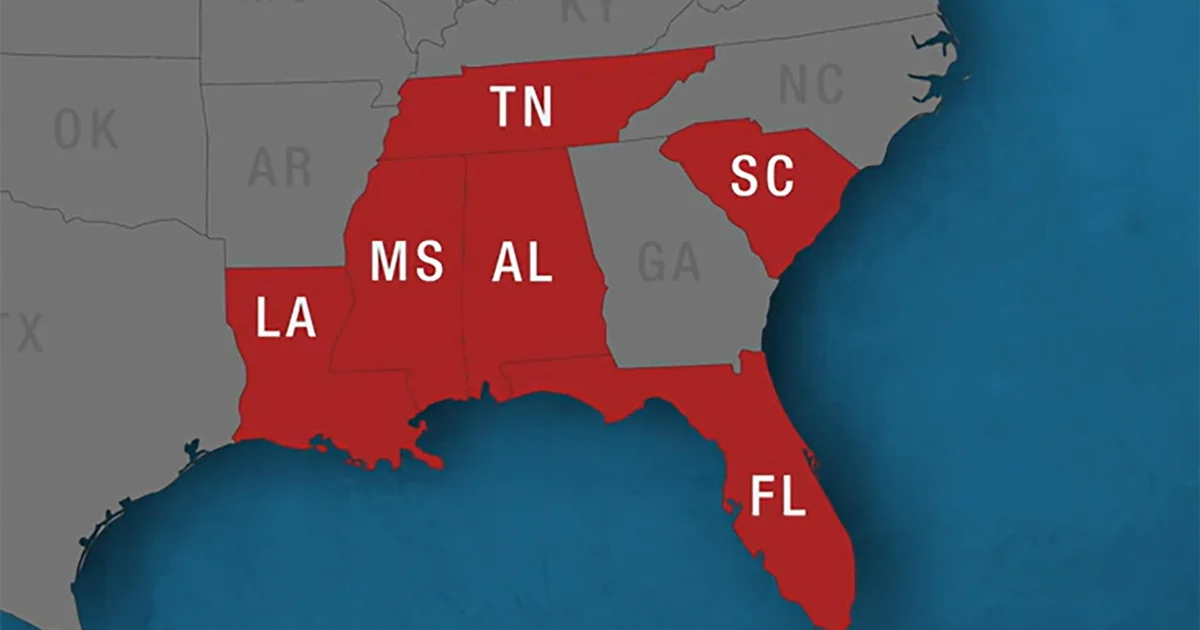
SouthernWorldwide.com – The U.S. Supreme Court’s recent ruling, which prohibits the drawing of voting districts based on race, has ushered in a new era of gerrymandering, potentially reshaping the political landscape across several states. This decision, made last month, marks a significant shift from the principles enshrined in President Johnson’s 1965 Voting Rights Act, a landmark civil rights legislation designed to dismantle barriers faced by Black voters.
The Court’s ruling stipulates that while racial considerations can no longer be the primary basis for redrawing electoral maps, partisan aims can now be used to shape these districts. This legal development has triggered a swift response in numerous states, with officials rushing to redraw voting districts to align with these new guidelines.
The implications of this ruling for American democracy are profound. National correspondent Robert Costa of “Sunday Morning” is set to explore these potential consequences in a discussion with key figures whose insights are crucial to understanding the future of electoral fairness and representation in the United States.
The Voting Rights Act of 1965 was a pivotal moment in the struggle for civil rights, aimed at ensuring that all citizens, regardless of race, could exercise their right to vote without undue obstruction. Its passage was a testament to the ongoing efforts to create a more inclusive and equitable democracy.
However, the Supreme Court’s recent interpretation of redistricting principles shifts the focus from racial considerations to partisan ones. This change opens the door for political parties to draw maps that favor their own interests, potentially leading to more polarized representation and a decrease in competitive elections.
Read more: Almanac: May 10
The immediate aftermath of the ruling has seen a flurry of activity in state capitals. Legislators and election officials are grappling with the complex task of redrawing congressional and state legislative districts in compliance with the new legal framework.
This process is often contentious, as different political factions have competing interests in how these lines are drawn. The potential for gerrymandering, now explicitly permitted along partisan lines, raises concerns about the fairness and representativeness of future elections.
The “Sunday Morning” segment featuring Robert Costa promises to delve into the nuances of this critical issue. By speaking with key voices, Costa aims to illuminate the potential ramifications of the Supreme Court’s decision on voter access, minority representation, and the overall health of democratic processes in the U.S.
The debate surrounding gerrymandering is not new, but the Supreme Court’s recent ruling may amplify its impact. Historically, gerrymandering has been used to dilute the voting power of specific communities or to create safe seats for incumbents, thereby reducing accountability and voter engagement.
The shift towards allowing partisan gerrymandering could further entrench existing political divisions. It raises questions about whether the principle of “one person, one vote” can be truly upheld when electoral maps are drawn primarily to benefit one party over another.
Experts suggest that this ruling could lead to a more predictable and less competitive electoral map, where the outcome of many elections is largely determined before votes are even cast. This scenario may discourage voter turnout and reduce the incentive for politicians to appeal to a broader range of constituents.
The conversation with key voices will likely explore potential solutions or mitigation strategies. These might include independent redistricting commissions, stricter enforcement of existing laws, or further legislative action to ensure fairer representation.
Understanding the historical context of the Voting Rights Act is essential to appreciating the significance of the Supreme Court’s departure from its original intent. The Act was a response to decades of discriminatory practices that systematically disenfranchised Black Americans.
Its aim was to prevent such practices and ensure that minority voters had an equal opportunity to elect representatives of their choice. The current ruling, by allowing partisan considerations to override racial ones, could inadvertently undermine these very protections.
The discussion will also likely touch upon the role of the judiciary in shaping electoral policy. The Supreme Court’s decisions have a direct and lasting impact on the structure of American governance and the balance of power between political parties.
As states move forward with the redistricting process, the public will be watching closely to see how these new rules are implemented and what impact they have on the upcoming elections. The focus will be on whether the spirit of representative democracy can be maintained amidst the new landscape of partisan gerrymandering.
The interview segment is expected to provide a comprehensive overview of the legal arguments, the political motivations, and the potential societal consequences of this landmark decision. It is a crucial moment for understanding the evolving dynamics of American elections and the ongoing pursuit of fair representation for all citizens.