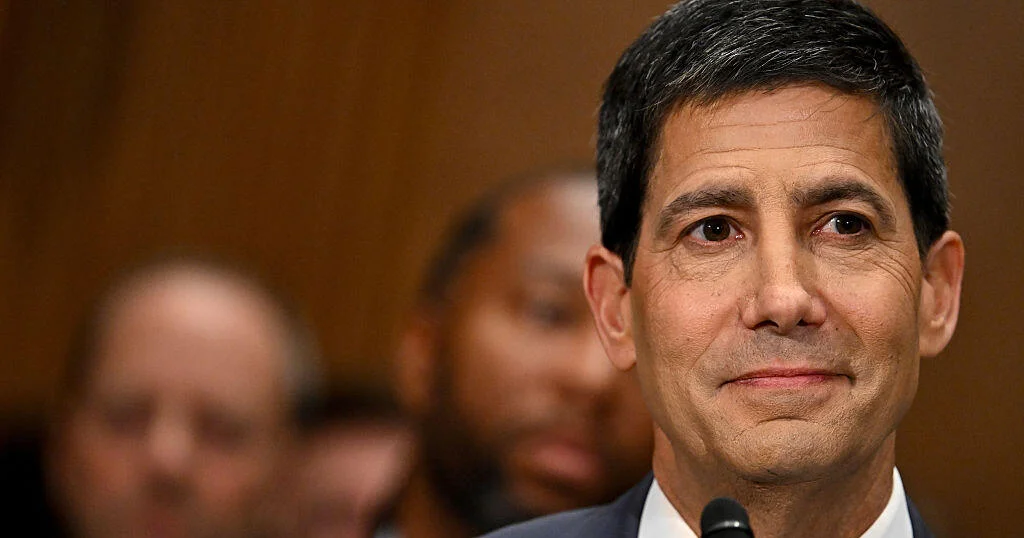
SouthernWorldwide.com – The U.S. Senate has officially confirmed Kevin Warsh as the new chairman of the Federal Reserve. This confirmation represents a significant win for President Trump, who has frequently expressed his desire for lower interest rates and has openly clashed with the outgoing Fed chair, Jerome Powell.
The confirmation vote concluded with a tally of 54-45. Notably, Democratic Senator John Fetterman from Pennsylvania cast his vote in favor of Warsh, aligning with all Republican senators.
Warsh is set to commence his four-year term as Fed chair this coming Friday. Jerome Powell has indicated his intention to remain as a regular member of the Fed’s board for the time being.
Earlier in the year, the Justice Department’s attempt to launch a criminal investigation into Jerome Powell caused unease among some Republican senators. These senators had previously stated they would withhold their support for any Fed nominees until the probe was officially dropped. The Justice Department eventually abandoned its investigation in April, which subsequently cleared the path for Warsh’s confirmation.
Warsh was also independently confirmed on Tuesday to serve as a member of the Federal Reserve’s seven-person Board of Governors. His term on the board is scheduled to conclude in 2040.
Warsh brings a wealth of experience to the role, having previously served on the Federal Reserve Board of Governors from 2006 to 2011. Following his tenure at the Fed, he took on a fellow position at Stanford University’s Hoover Institution. He later became a partner at the personal investment office of billionaire Stanley Druckenmiller.
In recent years, Warsh has been a vocal critic of the Federal Reserve’s policies. He has publicly called for a “regime change” at the central bank. He has also expressed skepticism regarding the Fed’s management of inflation following the COVID-19 pandemic, its approach to bank regulation, and the overall size of its balance sheet.
Read more : Conservatives Criticize Couple's 'Climate Refugee' Story After Troubled Texas Journey
Furthermore, Warsh signaled his support for lowering interest rates last year, a stance that aligns with President Trump’s economic priorities. However, many analysts have pointed out that Warsh has historically held hawkish views on monetary policy. This typically means he has prioritized concerns about inflation and generally favored higher interest rates.
President Trump’s desire for the Federal Reserve to lower interest rates to stimulate economic growth is not unprecedented. However, his persistent focus on this issue has raised concerns about the central bank’s ability to maintain its traditional independence from political influence.
During his Senate confirmation hearing last month, Warsh explicitly pledged to act as an “independent actor.” He emphasized the critical importance of monetary policy independence, stating, “Monetary policy independence is essential.”
Under Jerome Powell’s leadership, the Federal Reserve has adopted a cautious strategy regarding interest rate reductions. This cautious approach follows a period of significant rate hikes in 2022 and 2023, driven by concerns about reigniting inflation. This strategy has drawn sharp criticism from President Trump, who has publicly referred to Powell with various unflattering terms.
The situation became more complex earlier this year when the Federal Reserve received grand jury subpoenas. These subpoenas were part of an investigation by the Justice Department. Powell alleged that this probe was an attempt to intimidate him into cutting interest rates. However, prosecutors maintained that it was a legitimate inquiry into a costly Fed building renovation project and potential misrepresentations made by Powell during Senate testimony regarding the construction.
A judge ultimately sided with the Federal Reserve, quashing the subpoenas. The judge concluded that the subpoenas were intended to “harass” Powell.
This investigation presented a significant obstacle to President Trump’s objective of replacing Powell. Republican Senator Thom Tillis of North Carolina had declared he would not support any Federal Reserve nominees out of the Senate Banking Committee, including Warsh, until the Justice Department dropped the probe, which Tillis characterized as “bogus.”
U.S. Attorney for the District of Columbia, Jeanine Pirro, announced the closure of the investigation last month. However, she noted that the investigation could be reopened if a review by the Fed’s inspector general uncovers any wrongdoing. This development satisfied Senator Tillis, thereby removing the final hurdle for the Republican-controlled Senate to confirm Warsh.
Warsh assumes leadership of the Federal Reserve at a critical juncture, as the institution navigates the economic repercussions of the war in Iran. Jerome Powell had cited the conflict in Iran as a factor when the Fed’s Federal Open Market Committee voted last month to maintain its target interest rate unchanged for the third consecutive meeting.
“The economic outlook remains highly uncertain, and the conflict in the Middle East has added to this uncertainty,” Powell stated during a press conference last month. Inflation, while below its 2022 peak, still surpasses the Fed’s 2% target. The recent increase in energy prices, attributed to the war, has made it unclear when or if the central bank will deem it appropriate to lower interest rates.
The unemployment rate has remained relatively low, and the April jobs report indicated a strong labor market. Financial markets currently assess the probability of a rate cut this year as below 50%, according to CME Group’s FedWatch tool. Treasury Secretary Scott Bessent indicated last month that he would understand if the Fed chose to “wait for some clarity” before implementing rate cuts.
Despite these factors, President Trump has consistently advocated for interest rate reductions. Regardless of Warsh’s personal stance on interest rates, his influence over monetary policy will not be absolute. While the Fed chair typically wields considerable influence over the Federal Open Market Committee (FOMC), the chair is formally one of twelve voting members.
The FOMC comprises five regional Fed bank presidents, who are not appointed by the president, along with the seven governors of the Federal Reserve. Currently, three of the governors are nominees of President Trump, including Warsh, who replaced a previous Trump appointee. Three governors were nominated by President Biden. President Trump is currently seeking to remove Biden appointee Lisa Cook, but this action has been temporarily blocked by the courts.
Jerome Powell, originally an Obama-appointed Fed governor, was elevated to the position of chair during the first Trump administration and was re-nominated during the Biden administration. It has been customary for Fed chairs to step down from the board once their term as chair concludes. However, Powell has stated his intention to remain on the Fed board until the Justice Department’s probe, which he views as a threat to the Fed’s independence, is “well and truly over.”
Last month, Powell indicated he would remain on the board for an unspecified “period of time.” He also mentioned his plan to maintain a “low profile.” Powell explained his decision by referencing his prior experience as a rank-and-file Fed governor, stating, “I had real sympathy for how hard it is to get that group to consensus, and I always felt like I don’t want to add to that unnecessarily.”