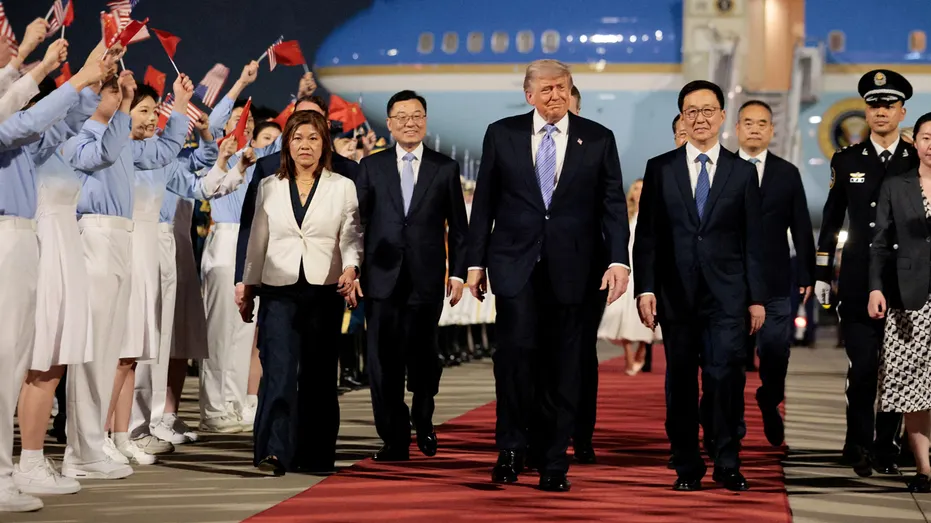
SouthernWorldwide.com – President Trump was met with a ceremonial red-carpet welcome upon his arrival in Beijing on Wednesday, complete with a military honor guard, a band, and children waving both American and Chinese flags, in anticipation of significant discussions with Chinese President Xi Jinping.
This elaborate reception also brought to the forefront the crucial question: can this visit achieve more enduring progress than Trump’s previous trip to China in 2017? That earlier visit, while marked by substantial business announcements, was later followed by a notable downturn in U.S.-China trade relations.
The current meeting occurs amidst escalating trade tensions, the ongoing Iran war, and disputes concerning Taiwan, all of which are placing increased pressure on Washington and Beijing to stabilize their relationship as the world’s two largest economies.
TRUMP HEADS TO BEIJING FOR HIGH-STAKES XI TALKS AS TAIWAN TENSIONS, TRADE DISPUTES TEST US STRENGTH
The welcoming ceremony featured a military honor guard, a military band, and young Chinese children enthusiastically waving the flags of both nations. The children were heard chanting “Welcome, welcome! Warm welcome!” in Chinese.
Upon disembarking from Air Force One, President Trump was greeted by a delegation including U.S. Ambassador to China David Perdue, Chinese Vice President H.E. Han Zheng, Ambassador of the People’s Republic of China to the United States H.E. Xie Feng, and Executive Vice Minister of Foreign Affairs H.E. Ma Zhaoxu.
First Lady Melania Trump had accompanied President Trump on his inaugural state visit to China nearly nine years prior. The 2017 trip was characterized by grandeur, personal diplomacy, and significant commercial announcements. It included cultural excursions such as a tour of the Forbidden City, a Peking opera performance, and a formal welcome ceremony at the Great Hall of the People.
Read more : Senate Confirms Kevin Warsh as Fed Chair Amid Trump's Push for Lower Rates
That 2017 visit resulted in the announcement of over $250 billion in commercial deals and cooperation pledges. However, this did not prevent a subsequent deterioration of trade relations in 2018.
Among the most significant announcements at the time, according to AP reports, were a $12 billion deal for cellphone chips from Qualcomm and $37 billion for Boeing commercial jets.
DONALD TRUMP DETAILS ‘MOST EXCITING PART’ OF CHINA TRADE AGREEMENT
At the time, the White House stated that these deals would stimulate job creation for American workers, farmers, and ranchers by boosting United States exports to China and encouraging investment within American communities.
A primary strategic focus of Trump’s first visit was North Korea’s nuclear program. Both Trump and Xi had agreed then that North Korea should not possess nuclear weapons and declared that the two countries would jointly apply “maximum pressure.”
China had already intensified its enforcement measures earlier that year, including a suspension of North Korean coal imports. President Trump later indicated that Chinese banks were reducing their business dealings with North Korean entities. However, U.S.-China cooperation began to wane as broader trade tensions escalated, while North Korea continued to advance its missile and nuclear programs.
The summit did not ultimately prevent a sharp decline in trade relations the following year, after President Trump implemented tariffs on Chinese imports, initiating a protracted trade standoff.
President Trump’s current visit follows a broader escalation of tariffs, where his administration imposed extensive duties on imports from numerous countries. China emerged as a central point of contention after retaliating and subsequently tightening export controls on rare earth minerals, prompting Trump to threaten an additional 100% tariff on Chinese goods.
President Trump is expected to once again confront Xi on trade issues, suggesting that American entrepreneurs and executives could contribute to growth within China if Beijing were to lower trade barriers and grant U.S. firms greater operational freedom.
TRUMP WARNS CHINA OF ‘STAGGERING’ 50% TARIFF IF CAUGHT SUPPLYING MILITARY AID TO IRAN
Accompanying President Trump on this trip are several prominent U.S. executives, including Elon Musk, Apple CEO Tim Cook, BlackRock CEO Larry Fink, Blackstone CEO Stephen Schwarzman, Boeing CEO Kelly Ortberg, Cargill CEO Brian Sikes, Citi CEO Jane Fraser, GE Aerospace CEO Larry Culp, Goldman Sachs CEO David Solomon, Micron CEO Sanjay Mehrotra, and Qualcomm CEO Cristiano Amon.
Iran is anticipated to be one of the key issues discussed during the talks, although President Trump has downplayed any significant differences with Xi concerning the war.
President Trump and President Xi are scheduled to hold bilateral discussions and a formal banquet on Thursday.