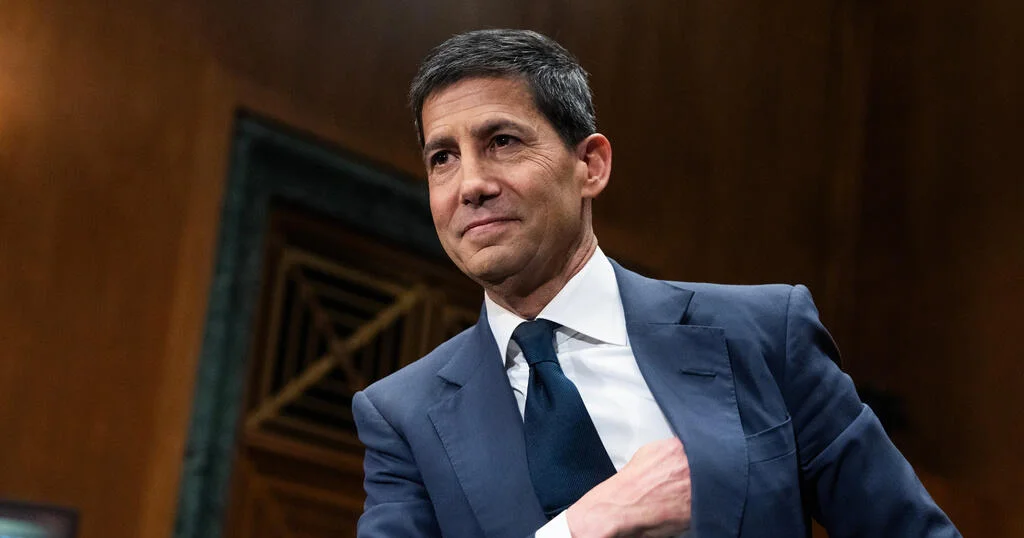
SouthernWorldwide.com – The Federal Reserve is set to welcome a new leader, Kevin Warsh, who was confirmed by the Senate for the position of Fed chair. While the President has expressed clear desires for lower interest rates, Warsh’s influence over these decisions is not absolute, and he will need to navigate a complex economic landscape and build consensus among the Federal Open Market Committee (FOMC) members.
Warsh, President Trump’s nominee, was confirmed in a 54-45 vote. The President has been vocal in his calls for the Fed to reduce interest rates and has criticized outgoing Chair Jerome Powell for not acting swiftly enough. Warsh has stated his commitment to being an “independent actor” and not basing policy decisions on the President’s views.
His first opportunity to weigh in on monetary policy will be at the next FOMC meeting. Warsh’s past statements suggest a nuanced position; he has shown some openness to rate cuts, but his previous tenure as a Fed governor was characterized by a preference for tighter monetary policy.
However, the ultimate decision on interest rates rests with the FOMC, not solely with the chair. While Fed chairs typically wield significant influence, their power is not unilateral. Experts emphasize that Warsh will need to foster agreement on the best course of action, a challenging task given current economic uncertainties, geopolitical concerns, and persistent inflation.
Most analysts anticipate that interest rates will remain unchanged in the coming months. Adding another layer of complexity, Jerome Powell is expected to continue serving on the Fed board, even after his term as chair concludes.
“The chair has the power to persuade,” stated Randall Kroszner, a former Fed governor who served with Warsh and is now a professor at the University of Chicago. He highlighted that while the chair is in a strong position to influence decisions, persuasion is still a necessary component.
Who actually sets interest rates?
The setting of interest rate targets is the responsibility of the Federal Open Market Committee (FOMC), which convenes eight times annually. Within this committee, the Fed chair holds just one vote among the 12 members.
Seven voting members of the FOMC are the Fed governors, who are nominated by the president and serve 14-year terms. This structure limits the direct control any single administration has over the Fed’s composition. Currently, three governors are appointees of President Trump, three are appointees of President Biden, and the seventh is Jerome Powell, initially appointed to the Fed board during the Obama administration and later named chair by President Trump.
The remaining five seats on the FOMC are held by the president of the New York Federal Reserve and four rotating presidents from the other 11 regional Fed banks. The White House has minimal influence over these regional Fed presidents, who are selected for five-year terms by their respective regional bank boards and then confirmed by the Fed’s Board of Governors.
This means that, at present, only a quarter of the voting members on the interest rate-setting committee are direct presidential appointees. Furthermore, there is no guarantee that these appointees will align with the president’s preferences, as demonstrated by Powell, who was appointed chair by President Trump.
The Fed chair’s “soft power”
Despite the formal voting structure, former Fed officials suggest that the chair’s influence on the FOMC extends beyond their individual vote.
Bill English, a former senior Fed staff member and current Yale University professor, explained that Fed chairs can cultivate “soft power” over time. This is achieved by consistently making sound decisions, which builds credibility with committee members, potentially leading them to be more receptive to the chair’s proposals.
Sarah Bloom Raskin, a former Fed governor and deputy Treasury secretary, noted that both the chair and other committee members generally aim for consensus. This collective agreement is perceived as stronger by the market, potentially leading to different reactions compared to a more divided vote.
The process of reaching consensus begins days before the FOMC meeting. The chair engages with regional Fed presidents and board members to gauge their perspectives. Raskin, now a professor at Duke University School of Law, indicated that members often have a clear understanding of each other’s typical stances before the formal meeting.
Economists and staff at the Fed’s Board of Governors report to the chair, meaning economic forecasts and analyses are often shared with the chair first. Kroszner added that the chair has considerable latitude in directing staff to focus on specific areas of economic inquiry.
During the two-day FOMC meetings, the chair and other members discuss the economic outlook and potential policy actions, including adjustments to the federal funds rate. Kroszner described the chair as the central figure in these discussions, guiding the development of policy options.
English summarized the chair’s role as one of continuous engagement and persuasion, aiming to move the committee as much as possible toward their desired outcome, even if it doesn’t perfectly align with their initial preferences.
The outcome of these deliberations is a concise statement outlining the committee’s decisions and its outlook for the economy. Investors closely analyze this statement for subtle shifts in language that might signal future policy intentions. Raskin pointed out that the wording of this statement is subject to intense debate among members.
While near-unanimous votes are common, dissents do occur, historically more often from regional Fed presidents. However, recent meetings have seen at least one Trump-appointed board member express a preference for lower rates than the committee ultimately supported.
Kroszner acknowledged that many of these decisions are close calls, and members might defer to the chair’s lead while still voicing their economic concerns.
What about Powell?
Warsh’s upcoming tenure as Fed chair may present a unique situation: the continued presence of his predecessor, Jerome Powell, on the Fed board. This scenario has not occurred in over 75 years.
Powell’s term as chair concludes on Friday, but his role as a governor extends until 2028. Unlike most chairs who depart the Fed upon leaving the chairmanship, Powell’s decision to remain is linked to a Justice Department criminal investigation.
The investigation, which concerned renovations to the Fed’s offices, was initiated by the U.S. Attorney’s office for D.C. Powell viewed this as an attempt by the Trump administration to pressure the Fed and undermine its independence, a claim prosecutors denied. While the investigation was closed last month, the possibility of its reopening remains dependent on criminal referrals from the Fed’s inspector general.
Powell has indicated his intention to stay at the Fed until the probe is “well and truly over.” He stated that his decisions are guided by what he believes is in the best interest of the institution and the public it serves.
Read more : Trump's China visit: Red carpet, but with a history of limits
This means Powell is poised to be the first former Fed chair to remain on the board since Marriner Eccles’s chairmanship ended in 1948.
Regarding Powell’s potential influence on interest rate decisions, he has stated his intention to maintain a “low profile.” When asked for clarification, he offered a brief, somewhat wry explanation.
“I respect the role of the chair,” Powell remarked, drawing on his six years as a governor before becoming chair. He expressed empathy for the challenges of achieving consensus within the committee and stated his desire not to create unnecessary complications.
Powell’s aim is to be “very constructive” and to “support… the direction the chair wants to go in, if you can.” He has explicitly ruled out acting as a “shadow chair” with undue influence over other members.
Nevertheless, experts suggest that Powell may attract more attention than a typical committee member. Raskin believes his presence will be noted, and his views will be closely observed, especially by the Fed’s existing staff who are familiar with him.
English described Powell as a “respected figure” with over a decade of experience at the Fed, implying that his contributions to FOMC discussions will be taken seriously. He also expressed confidence that Powell would strive to avoid being obstructionist.
Fed isn’t expected to make any big moves right away
The prevailing view among experts and investors is that the Federal Reserve is unlikely to make significant shifts in interest rates simply due to Warsh’s assumption of the chair position.
The FOMC’s mandate includes maintaining high employment and stable prices. Balancing these objectives can be difficult; overly aggressive rate cuts could stimulate the economy but also lead to runaway inflation, while steep rate hikes to combat inflation might stifle economic growth.
The committee increased rates in 2022 and 2023 to address inflation. Since then, a more cautious approach has been adopted, with rate reductions occurring in late 2024 and late 2025. Rates have remained steady through the first three meetings of the current year, with employment levels relatively stable and inflation still exceeding the Fed’s 2% target. Powell has recently cited the war with Iran as a source of economic uncertainty that warrants careful consideration.
The Fed is widely expected to maintain current interest rate levels for the foreseeable future. According to CME Group’s FedWatch tool, the probability of an interest rate change at any of the remaining five meetings this year is below 40%.
Bank of America analysts recently predicted that the Fed would delay any rate cuts until the latter half of 2027, citing an increase in inflation and robust job market figures. New federal data released on Tuesday indicated that inflation rose to 3.8% year-over-year in April, the highest point since mid-2023, potentially making rate cuts even less probable.
Warsh’s specific immediate objectives concerning interest rates are not entirely clear.
He has previously advocated for lower rates and has suggested that artificial intelligence could lead to significant productivity gains, thereby curbing inflation and allowing for a more accommodative monetary policy. However, some economists, like Chicago Fed President Austan Goolsbee, have cautioned that the hype surrounding AI could, conversely, exacerbate inflation.
During his earlier tenure on the Fed board (2006-2011), Warsh was characterized as a “hawk,” indicating a concern for inflation and a tendency to support tighter monetary policies.
Warsh has also called for a fundamental shift in the Fed’s operational framework, suggesting that central bank officials should communicate their views more transparently and avoid making overly definitive predictions. His proposed changes span various aspects of the Fed’s operations, from its balance sheet size to its regulatory practices.
During his Senate confirmation hearing, Warsh stated that President Trump had not requested him to predetermine or decide on any interest rate decisions. He also expressed his intention to solicit a range of views from FOMC members and favored more “messy meetings” over overly structured ones.
English believes it is unlikely that Warsh will immediately push for lower interest rates, given the current economic uncertainty and apparent divisions among committee members.
“I don’t think he’s going to be able to get the committee there right away,” he commented.
Raskin suggests that if Warsh intends to advocate for lower rates, proponents of such a move would need to present a compelling, analytically sound, and disciplined case that is broadly convincing.
Kroszner, who worked with Warsh on the Fed board and in the George W. Bush administration, described Warsh as a “long-run strategic thinker” who prioritizes building consensus.
“He understands that to get things done, you need to … build a consensus around things,” Kroszner stated. “You can’t just come in and say, ‘Off with their heads, I want to do this or I want to do that.’ That’s not going to be very effective.”