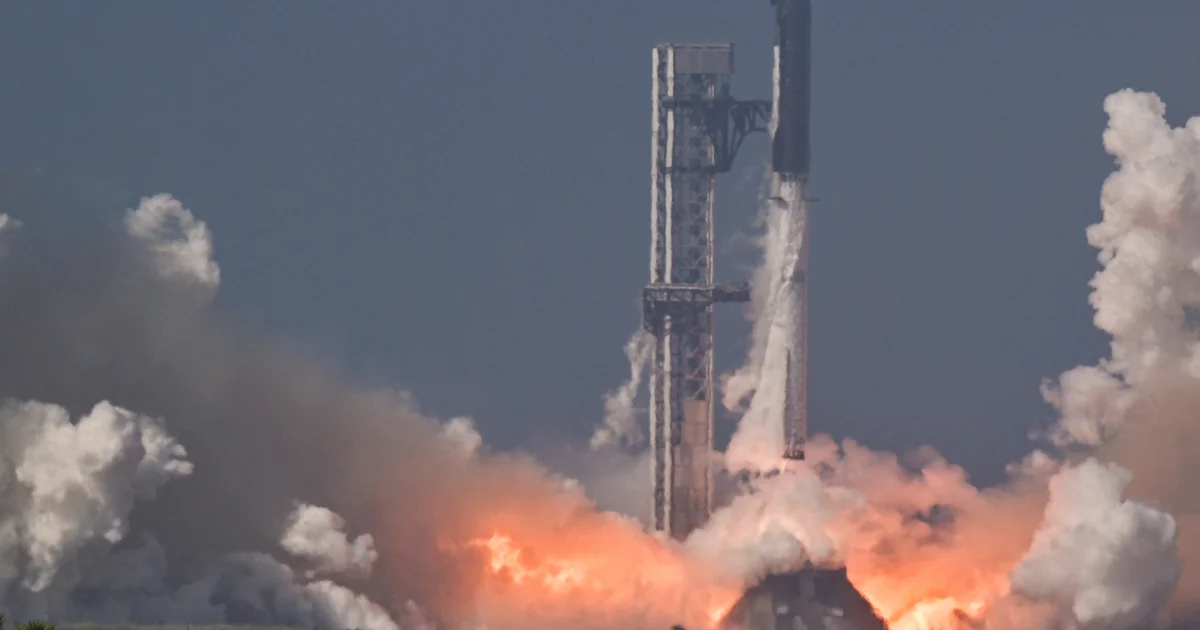
SouthernWorldwide.com – SpaceX successfully launched a more powerful version of its Super Heavy-Starship rocket on Friday for a crucial test flight. The mission aimed to validate a range of upgrades, including enhanced engines, improved control systems, and other modifications designed to boost operational efficiency, safety, and reliability.
During the ascent, one of the 33 Raptor 3 engines powering the Super Heavy first stage experienced an early shutdown. Additionally, several other engines did not perform as expected during the planned return maneuver for a splashdown off the Texas Gulf Coast.
The Starship upper stage was equipped with six third-generation Raptor engines. One engine optimized for vacuum operations shut down prematurely during the climb to space. However, the flight computer compensated by keeping the remaining five engines operational longer than anticipated, allowing the spacecraft to achieve a suitable sub-orbital trajectory.
The exact cause of the early engine shutdowns remains under investigation. Despite this issue, the Starship upper stage performed well in space. It successfully deployed 22 Starlink internet satellite simulators from an upgraded dispenser. Notably, two of these simulators were equipped with cameras, capturing images of the Starship from their own perspective.
These camera feeds are intended to help assess the condition of the Starship’s heat shield tiles on future flights. The ultimate goal for Elon Musk’s company is to utilize the Starship for launching large constellations of next-generation Starlink satellites, as well as government and commercial payloads. Long-term plans also include missions to the moon and Mars.
In a post on his X platform, Musk congratulated SpaceX for “an epic first Starship V3 launch & landing! You scored a goal for humanity.”
The upgraded Super Heavy-Starship lifted off around 6:30 p.m. EDT from a newly reinforced launch pad at SpaceX’s Starbase facility on the Texas Gulf Coast. The launch occurred after a last-minute scrub on Thursday due to a minor issue with a launch pad system, preceded by two weather-related delays.
The 33 Raptor engines at the base of the Super Heavy first stage generated up to 18 million pounds of thrust, twice the liftoff power of NASA’s Space Launch System (SLS) moon rocket. This immense power propelled the 407-foot-tall rocket skyward amidst a brilliant display of blue-white fire.
NASA Administrator Bill Nelson also congratulated SpaceX and Musk on social media, stating it was “a hell of a V3 Starship launch. One step closer to the Moon…one step closer to Mars.”
This marked the first flight of a “Version 3” Super Heavy-Starship and the inaugural use of SpaceX’s second Texas launch pad. This new pad is designed to better withstand the stresses of repeated launches by the world’s most powerful rocket.
Two minutes and 24 seconds after liftoff, as the Starship upper stage’s six Raptor engines ignited just as the Super Heavy first stage separated, the rocket was already beyond the dense lower atmosphere.
The booster immediately executed a planned flip maneuver to begin its return trajectory for a controlled splashdown in the Gulf of Mexico. Meanwhile, the Starship upper stage continued its ascent into space.
However, several Raptor engines on the booster failed to ignite as expected. This prevented the booster from reaching its intended splashdown point, causing it to fall into the Gulf short of its target.
Despite the single engine failure during ascent, the Starship upper stage successfully achieved an acceptable sub-orbital trajectory. The Starlink simulators were deployed as planned. A planned in-space restart of a Raptor engine was not attempted.
The test flight concluded on a positive note regarding the Starship’s re-entry. The spacecraft appeared to withstand the intense heat of atmospheric re-entry in good condition, showing less thermal damage compared to previous flights.
During its descent, the Starship successfully performed a maneuver designed to test the structural integrity of its rear fins. It also executed a dramatic banking maneuver, similar to what future operational Starships will perform during landings.
Just before impacting the Indian Ocean, the Starship reignited two engines, rotated to a vertical position, and descended for an on-target splashdown. It then tipped over as anticipated, broke apart, and exploded in a spectacular fireball.
Aside from the single Raptor engine failure during ascent, the Starship appeared to meet SpaceX’s objectives, demonstrating resilience through the stresses of launch and re-entry.
A Milestone Towards Lunar Missions
The Version 3 test flights represent significant advancements for SpaceX as the company strives to perfect its fully reusable rocket system. This system is intended for operational use in launching government and commercial satellites, scientific probes, and eventually, crewed missions to Mars.
These flights are also critical for NASA, which has contracted SpaceX to develop a version of the Starship upper stage to serve as a lunar lander. This lander is slated to transport NASA’s Artemis astronauts to the moon’s surface, with the first crewed landing planned for 2028. Following this, NASA intends to conduct multiple missions annually and establish a base near the moon’s south pole.
In the interim, NASA’s next Artemis mission is scheduled for 2027. This mission will send four astronauts in an Orion capsule atop an SLS rocket to rendezvous in Earth orbit with SpaceX’s lander and an alternative lander being developed by Blue Origin.
NASA plans to conduct tests with both landers during the Artemis III mission. The mission will proceed even if only one lander is operational. Both SpaceX and Blue Origin are required to successfully complete an uncrewed lunar landing mission before NASA attempts to land astronauts in 2028.
Neither company has yet successfully placed a lunar lander into space, and both face demanding test schedules. With the availability of the Version 3 Starship, SpaceX is focused on transitioning from sub-orbital test flights to orbital missions. Concurrently, the company is continuing its efforts to refine the systems essential for lunar missions.
A key challenge is the development of the capability to autonomously refuel a Starship lander in Earth orbit before it can embark on deep space journeys. The Version 3 Starship now incorporates the necessary attachment points and fuel-transfer systems for these operations.
Read more : Pressure' Review: Brendan Fraser Embodies Eisenhower in Gripping WWII Drama Leading Up to D-Day
SpaceX has indicated that the first in a series of orbital refueling tests is scheduled to take place before the end of the year.