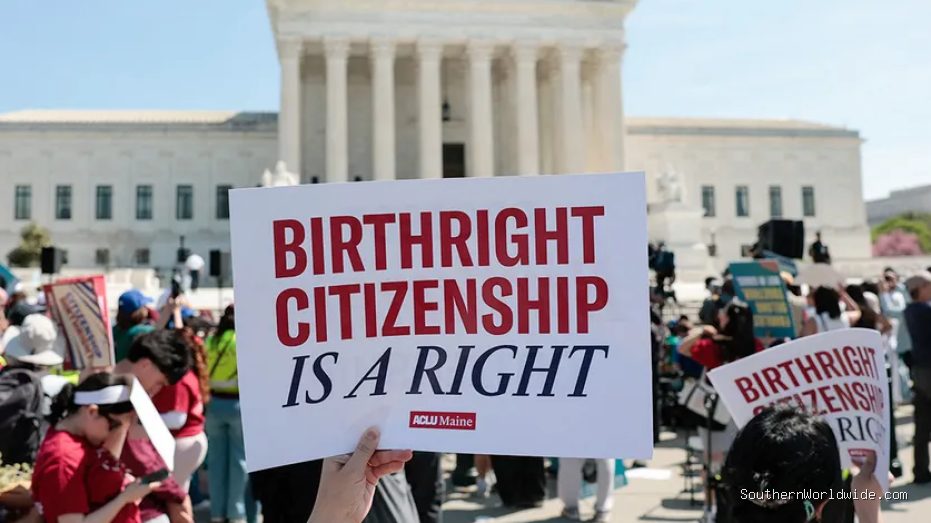
SouthernWorldwide.com – The Supreme Court’s recent decision in the birthright citizenship case, Trump v. Barbara, has been met with strong criticism, with some arguing it will lead to negative consequences for the United States.
The court’s ruling stated that children born in the U.S. to parents who are unlawfully or temporarily present are still considered “subject to the jurisdiction” of the United States. This means they are granted citizenship at birth under the Fourteenth Amendment.
Critics contend that this ruling allows individuals with no allegiance to the U.S. to confer the benefits of American citizenship upon their children without requiring any reciprocal responsibilities.
This situation draws a parallel to the “Trojan Horse” from Greek mythology, described as a “Hunan Horse” in this context. The argument is that this tactic, combined with the lack of federal and state laws specifically prohibiting surrogacy, could lead to millions of individuals entering the U.S. as citizens.
Wealthy Chinese nationals, for instance, are said to exploit birthright citizenship for financial gain. This includes securing lower tuition fees for their children in public schools and potentially sponsoring their own immigration later on. Concerns are also raised about corrupt Chinese officials, senior military, and intelligence officers who may use this route for more concerning purposes, such as enabling their children to vote, join the military, or obtain security clearances for federal positions.
The practice is not limited to Chinese nationals. Wealthy individuals from Nigeria, Russia, and other countries, whose wealth is often alleged to be derived from corruption, are also reportedly engaging in similar “birth tourism packages,” which may include amenities like shopping and spa services.
Many individuals who allegedly abuse birthright citizenship are described as being of lower economic status and immediately accessing public benefits. The assertion is that these individuals should be denied visas as probable public charges under U.S. immigration law. However, it is claimed they often misrepresent their assets, ties to their home countries, and reasons for travel. Furthermore, there’s a suggestion that consular officers have been instructed to disregard welfare benefits when assessing ineligibility.
Experiences shared by consular officers serving in developing countries reportedly include instances of mothers applying for tourist visas who already have children who are U.S. citizens. In many of these cases, the mothers allegedly did not pay their hospital bills and had utilized welfare and healthcare programs intended for low-income American mothers and children.
A particularly concerning aspect highlighted is the case of individuals like Hasan Piker, described as a “progressive” figure. He was born in the U.S. while his Turkish parents were on student visas. Although raised in Turkey, he later returned to the U.S. and gained prominence for his online commentary, which is characterized as antisemitic, anti-American, and anti-capitalist.
While the Trump v. Barbara case has set a precedent for now, the question remains about potential actions to address the situation. One proposed legislative approach involves Congress passing a law that clarifies that, for the sole purpose of acquiring U.S. citizenship, the phrase “subject to the jurisdiction thereof” in the Fourteenth Amendment does not apply to individuals whose parents were citizens of other nations at the time of their birth. This measure is suggested to align with Justice Brett Kavanaugh’s potential stance, though it would still face a 5-4 majority unless court composition changes.
A more ambitious, albeit long-shot, solution proposed is amending the Constitution. The 13th, 14th, and 15th Amendments are cited as examples of how constitutional changes have addressed significant societal issues. The argument is that the original intent of the 14th Amendment was to protect freed Black Americans, not to benefit individuals engaged in birth tourism.
The historical precedent of the 18th Amendment (Prohibition) being repealed by the 21st Amendment is used to suggest that the 14th Amendment could also be revised. A new amendment, it is proposed, could clearly define the citizenship or immigration status requirements for at least one parent for a child born in the U.S. to be granted citizenship at birth.
In the interim, Congress and state governments are encouraged to enact laws that ban surrogacy and impose costs on foreign nationals who give birth in the U.S. at the expense of taxpayers.
The current U.S. laws governing international surrogacy are described as lax, allowing foreign nationals to utilize American women for surrogacy. The resulting children are granted full American citizenship. This cross-border surrogacy for hire lacks national regulation in the U.S., and approximately half of U.S. states are said to actively promote the industry. California is specifically mentioned, with 75% of foreign intended parents reportedly using clinics there. The fact that commercial surrogacy is illegal in China, yet permitted in some U.S. states, is questioned.
On an international level, the State Department is urged to strengthen visa adjudication standards in countries known for abusing birthright citizenship. Women of childbearing age are already required to demonstrate their intent to return, possess sufficient funds for support, and provide a valid reason for traveling to the U.S. The use of AI-driven estimations is suggested to assist consular officers in assessing the risks associated with issuing visas.
Furthermore, it is proposed that women who have previously had children in the U.S. on visitor visas or who have claimed public benefits while in the country should be barred from re-entering for any reason. The application of AI and improved data management could help consular officers reduce the number of women arriving with the intent to give birth and prevent repeat instances.
Many conservatives reportedly anticipated a loss in the Barbara case but are now focused on mitigating the potential damage. The availability of tools to address the situation is highlighted, with an emphasis on their utilization.