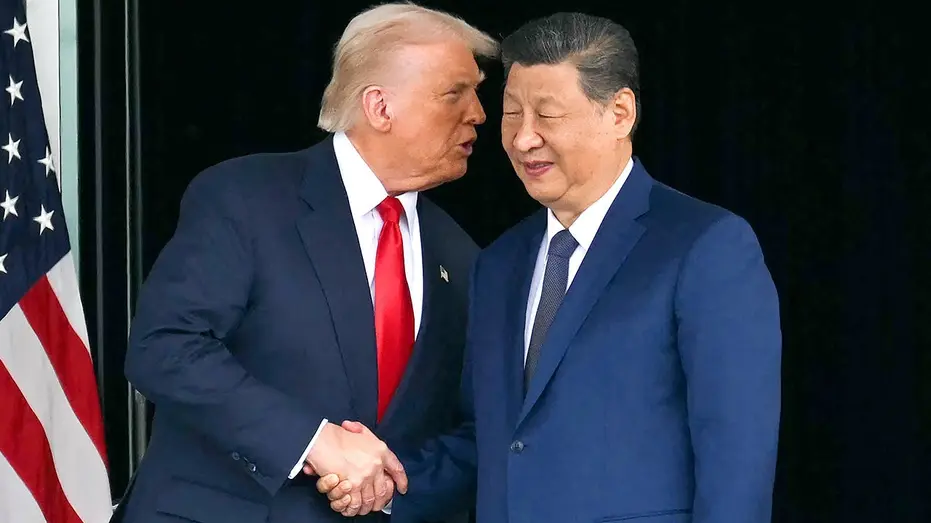
SouthernWorldwide.com – President Donald Trump arrives in Beijing with a strong hand to play in talks with China’s President Xi Jinping, largely due to his military and trade moves over the past 16 months.
Contrary to much press coverage suggesting impending doom and China holding the upper hand, the reality is that Trump has significantly strengthened America’s geopolitical position relative to China.
While outlets like The Washington Post and the Council on Foreign Relations have asserted that Trump is weakened by the Iran conflict and Xi is poised for global leadership, this perspective overlooks crucial developments.
Just last spring, China was actively disrupting global factory production by revoking export licenses for critical minerals. Now, the U.S. Navy strategically patrols the Strait of Hormuz, a vital oil route for China.
Meanwhile, Xi Jinping has spent the past year dealing with internal challenges, including purges of military officers, a slowing economy, and attempts to catch up in the artificial intelligence race by focusing inward.
In stark contrast, President Trump has successfully negotiated trade deals worldwide, attracting trillions of dollars in foreign investment.
He has also significantly curbed Iran’s military capabilities and played a role in the removal of Nicolas Maduro from power in Venezuela.
Furthermore, the U.S. Pacific Fleet has intercepted illicit shadow tankers attempting to supply Iranian oil to China’s refineries, a sophisticated display of military power that has garnered attention from China’s People’s Liberation Army.
Despite some China experts cautioning that Trump might be forfeiting prestige by meeting on Xi’s home turf, the opportunity is irresistible for Trump.
He is accompanied to Beijing by a formidable delegation of American CEOs, leaders in fields ranging from space exploration with Elon Musk of Tesla and SpaceX, to advanced aircraft engines with Larry Culp of GE Aerospace.
This direct engagement is crucial for Trump, who believes there is no substitute for face-to-face negotiations at the table.
The upcoming discussions in Beijing are expected to focus on four major areas of importance.
This is fundamentally a business trip, as the Trump administration is deeply concerned about the impact of China’s rise on the United States.
Encouragingly, U.S. Trade Representative Jamieson Greer testified on April 28 that the trade deficit in goods with China fell to $202 billion in 2025, the lowest since 2004, and China’s share of U.S. imports dropped to about 9 percent, the lowest since its WTO accession in 2001.
Trump’s current objective is to foster a stable, balanced, and civil relationship with China.
Baca juga di sini: Brazil's Carlo Ancelotti Faces Tough Neymar World Cup Squad Choice
His proposed policy of “managed trade” involves direct negotiation between the U.S. and China on tariffs, sector by sector, and an expansion of trade in non-sensitive goods.
Agriculture, including exports of soybeans, dairy, and corn, is a top priority, with farmers hoping for a long-term agreement, despite past unfulfilled promises from China.
Aviation industry observers anticipate Boeing could secure orders for up to 500 airliners, with CEO Kelly Ortberg joining the trip, all part of Trump’s strategy to reduce the trade deficit and maximize American sales.
Trump is also expected to address China’s sale of sodium perchlorate and other chemicals used in ballistic missile fuels to Iran.
Beijing is already showing signs of anxiety, with Secretary of State Marco Rubio recently imposing sanctions on Chinese satellite imagery companies and Qingdao Haiye Oil Terminal Co. for receiving Iranian oil.
This potential disruption to oil supplies could significantly impact China’s plastics and chemicals industries and stunt its economic growth.
While discussions on AI safety might occur, the U.S. must prioritize winning the AI race rather than pursuing superficial agreements.
As of May 1, 2026, the U.S. National Institute of Standards reports that the leading U.S. model, OpenAI GPT 5.5, holds an approximate eight-month lead over China’s DeepSeek V4 Pro.
A world where Xi Jinping dictates AI standards is undesirable. America’s strongest advantage lies in the unfettered success of its tech titans and startups.
These companies are leading the race through model innovation and by deploying their AI technology stacks across global markets ahead of China.
Only the U.S. tech sector possesses the financial capacity to compete effectively with China.
China remains a formidable military competitor, continuing to reclaim land for new bases in the South China Sea and having doubled its nuclear missile arsenal from approximately 250 to over 600 weapons, with massive expansion ongoing.
However, Trump’s strategic combination of trade agreements and military deterrence serves as compelling evidence of America’s enduring global leadership.