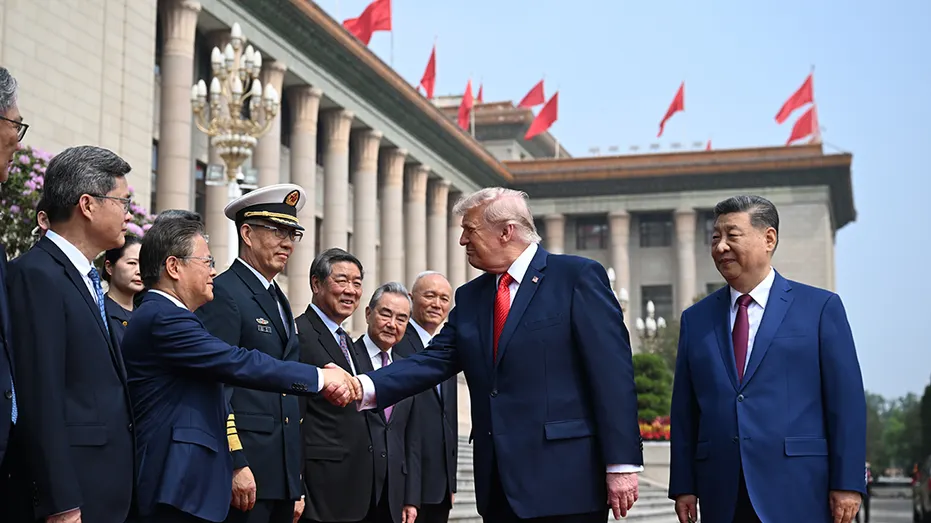
SouthernWorldwide.com – President Donald Trump arrived in Beijing for a critical summit with Chinese President Xi Jinping, a meeting aimed at stabilizing the significant rivalry between the two global powers without compromising on core strategic disagreements.
This two-day visit marks Trump’s first journey to China since 2017. It occurs amidst heightened tensions concerning trade, artificial intelligence, Taiwan, and the repercussions of conflicts in the Middle East.
While the White House has positioned this summit as a chance for new economic pacts and a recalibration of U.S.-China relations, experts suggest that Beijing’s objectives are more extensive and long-term.
“Trump is seeking headline-grabbing deals and visible progress ahead of the midterm elections,” noted Zongyuan Zoe Liu, a senior fellow in China studies at the Council on Foreign Relations. “Xi, however, is playing a more strategic, long-term game, prioritizing patience over substantial concessions.”
TRUMP HEADS TO BEIJING FOR HIGH-STAKES XI TALKS AS TAIWAN TENSIONS, TRADE DISPUTES TEST US STRENGTH
The agenda for the summit was expected to include agreements on trade, aerospace, agriculture, and energy. Additionally, discussions were slated for the establishment of a U.S.-China Board of Trade and Board of Investment.
White House spokesperson Anna Kelly stated that Trump’s aim was to “deliver more good deals on behalf of our country” while simultaneously safeguarding U.S. national security interests.
The U.S. President participated in a welcoming ceremony and held bilateral meetings with Xi on Thursday morning local time in Beijing. This was followed by a tour of the Temple of Heaven with the Chinese leader and a state banquet later in the day.
Liu Pengyu, a spokesperson for the Chinese Embassy, indicated that Beijing views the summit as a crucial opportunity to stabilize the relationship between the world’s two largest economies.
For Xi, analysts believe the paramount priority is to prevent further escalation with Washington. This approach would also grant China more time to address its decelerating economy, which is grappling with weak domestic demand, deflationary pressures, and industrial overcapacity.
A recent report from the U.S.-China Economic and Security Review Commission highlighted that Beijing is intensifying its state-led industrial policies, despite significant structural weaknesses within its economy.
The commission’s findings suggest that China is increasingly operating with a “two-speed” economy. While a large portion of the economy experiences stagnation, sectors designated as priorities by the Chinese Communist Party receive substantial state backing, leading to expansion that exceeds market demand.
The report also raised concerns about a new “China Shock 2.0.” It argued that China’s excess industrial capacity and record trade surpluses are disrupting global markets. This situation, the report warned, is increasing global reliance on Chinese-controlled supply chains in critical sectors such as batteries, pharmaceuticals, semiconductors, and artificial intelligence.
“Chinese policy aims to simultaneously reduce China’s dependence on foreign technology while increasing the world’s reliance on China,” the commission stated in its findings.
TRUMP TO CONFRONT XI AT HIGH-STAKES SUMMIT OVER CHINA BACKING FOR IRAN, RUSSIA
Concurrently, Xi possesses leverage stemming from the ongoing crisis in Iran and global energy market disruptions.
Trump has faced increasing domestic pressure due to rising energy prices, which are linked to instability in the Middle East and threats to shipping near the Strait of Hormuz. China, meanwhile, remains a major oil customer for Iran and maintains political ties with Tehran.
Susan Thornton, who served as acting assistant secretary of state for East Asian and Pacific affairs during Trump’s first term, expressed during a recent interview with the Stanford University Asia-Pacific Research Center that expectations for significant breakthroughs should be tempered, despite the symbolic importance of the summit.
“The primary value lies in the act of meeting itself,” Thornton commented.
She suggested that Beijing might perceive a strategic advantage in America’s heightened focus on the Middle East. While China has offered nominal peace proposals, it has not actively engaged as a mediator.
“It seems like they are kind of hanging back and waiting to see what will happen,” Thornton observed. She argued that from Beijing’s perspective, U.S. involvement in the Middle East could serve as a useful distraction, diverting Washington’s attention and pressure away from China.
One area where tangible progress might be announced is agriculture.
According to a Reuters report from Tuesday, the White House has been urging Beijing to increase its purchases of U.S. farm products ahead of the summit, particularly soybeans and grains.
However, traders and analysts informed Reuters that China’s capacity for major new soybean commitments might be constrained by weak domestic demand and the availability of cheaper alternatives from Brazil. Instead, market observers are anticipating potential agreements concerning corn, sorghum, wheat, beef, and poultry – sectors considered less politically sensitive within the broader U.S.-China relationship.
More than a dozen U.S. business executives, including leaders from the agricultural giant Cargill, accompanied Trump on his visit.
PRESIDENT TRUMP MUST PUT AMERICAN HOSTAGES FIRST IN HIGH-STAKES BEIJING SUMMIT
Despite the focus on trade and geopolitical tensions, survivors of China’s religious persecution have urged the administration not to overlook Beijing’s crackdown on religious groups and dissidents.
Prior to the summit, Trump publicly committed to raising the case of imprisoned Chinese pastor Ezra Jin, following advocacy efforts by his daughter, Grace Jin Drexel, who has accused Beijing of persecuting Christians.
Taiwan and technology restrictions are also expected to be significant topics during the talks. Beijing continues to oppose U.S. arms sales and its support for Taiwan, while Washington has strengthened export controls targeting China’s advanced semiconductor and AI sectors.
Nevertheless, despite the escalating rivalry, neither Washington nor Beijing appears eager for direct confrontation.
For Trump, the summit presents an opportunity to highlight economic achievements and diplomatic engagement in the lead-up to the 2026 midterm elections.
Read more : New Job: Teaching AI How to Do Your Work
For Xi, analysts suggest, the objective is more measured: to maintain stability, avoid conflict, and continue positioning China for a prolonged strategic competition with the United States.