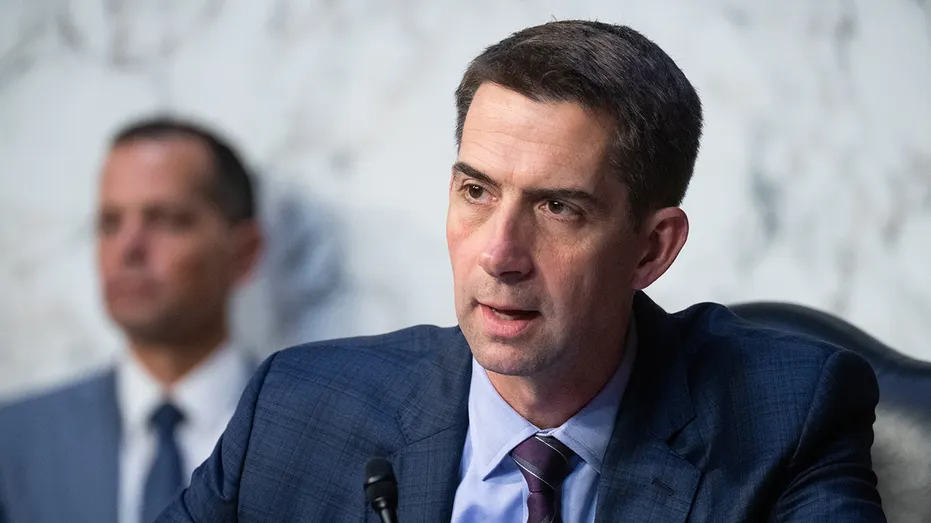
SouthernWorldwide.com – Senator Tom Cotton has urged the Department of Justice (DOJ) to investigate potential Chinese efforts to undermine American advancements in artificial intelligence (AI) and data center development.
In a letter addressed to Acting Attorney General Todd Blanche, the Republican senator from Arkansas called for federal investigators to examine whether foreign entities are attempting to influence U.S. public opinion and policy against these critical infrastructure projects. This call comes amid a growing competition between Washington and Beijing for dominance in the field of artificial intelligence.
“Americans should decide their own future free of communist propaganda. I’m encouraging the Department of Justice to investigate,” Cotton stated.
Cotton’s request follows the release of a report by the Bitcoin Policy Institute, a Washington, D.C.-based think tank. The report alleges that Chinese state media, foreign-funded advocacy groups, and a network of organizations supported by American tech tycoon Neville Roy Singham have spent years cultivating opposition to the construction of U.S. data centers and AI infrastructure projects.
For years, groups funded by Singham have collaborated closely with two self-described communist organizations in the U.S. These groups include the ANSWER Coalition and the Party for Socialism and Liberation. They have mobilized activists to protest against major U.S. technology, defense, and logistics companies.
Companies such as Palantir Technologies, Lockheed-Martin, and Google have been targeted. The aim is to publicly shame these firms for their business dealings with the U.S. government. These dealings cover a range of issues, from immigration to global geopolitics where China holds significant interests.
These interests span regions including Israel, Iran, Venezuela, Cuba, South Korea, and even Greenland. Pro-China protestors have leveraged concerns over the high electricity costs associated with operating data centers. A prominent theme in recent protests has been the rising utility bills experienced by consumers.
Earlier this year, Senator Cotton introduced a bill known as the “DATA Act of 2026.” This proposed legislation aims to remove regulatory controls. It would enable manufacturers, data centers, and other energy-intensive industries to establish new electricity systems independently of the consumer electrical grid.
More broadly, lawmakers in both the Senate and the House of Representatives have initiated inquiries into the nonprofits within the Singham network. They are questioning whether these groups should be mandated to register as “foreign agents” under the Foreign Agents Registration Act (FARA).
FARA requires entities or individuals working in the interests of foreign powers to register with the U.S. Justice Department as foreign lobbyists. “Alarming reports indicate that a network of foreign actors, led by the Chinese Communist Party (CCP), is attempting to manipulate U.S. policy and public opinion on data centers,” Cotton wrote in his letter.
The report from the Bitcoin Policy Institute, titled “Foreign Influence in the Campaign Against American AI,” details allegations of three distinct streams of influence. These include Chinese state media, the Singham network, and foreign-funded advocacy organizations. These entities have increasingly converged their efforts to obstruct or delay new AI-related infrastructure within the United States.
Following their wedding in early 2017, Neville Roy Singham and his partner, Jodie Evans, have significantly reshaped far-left protests in the United States. They have created a system that appears to orchestrate new protests from centralized command-and-control centers within the Singham network.
This network reportedly produces pre-printed protest signs and disseminates common messaging. It galvanizes support around shared themes that advocate for China and condemn the United States. The rhetoric often mirrors Russian and Chinese propaganda, portraying the U.S. as an “imperialist nation.”
According to the Bitcoin Policy Institute’s report, the Singham network “has spent nearly five years producing parallel domestic content opposing U.S. AI infrastructure, AI labs, and AI export controls.” The report argues that this campaign against American AI infrastructure provides a strategic advantage to Beijing.
This is particularly significant at a time when China is heavily investing in its own AI capabilities. “While Beijing’s state media warns American audiences that data centers are environmentally and economically dangerous, the Chinese state subsidizes up to half of the energy costs of its own AI data center operators,” the report highlights.
The issue has gained considerable attention as policymakers, investors, and technology leaders voice concerns that the U.S. risks falling behind China. This potential lag is attributed to the nation’s failure to rapidly expand the computing infrastructure necessary to power next-generation AI systems.
One of the most prominent advocates for expanded AI infrastructure is billionaire investor Kevin O’Leary. He has argued that data centers, power generation, and advanced computing capacity are now crucial strategic assets in the global race for artificial intelligence leadership.
The broader concern, echoed by Cotton, O’Leary, the Bitcoin Policy Institute, and others, is that pro-China campaigns opposing U.S. AI infrastructure are promoting narratives that ultimately benefit Beijing. This occurs as the United States and China compete for technological and economic supremacy.
Cotton also noted in his letter that a figure named Lan is affiliated with Tsinghua University. This institution is frequently scrutinized by U.S. officials due to its role in China’s military-civil fusion strategy.