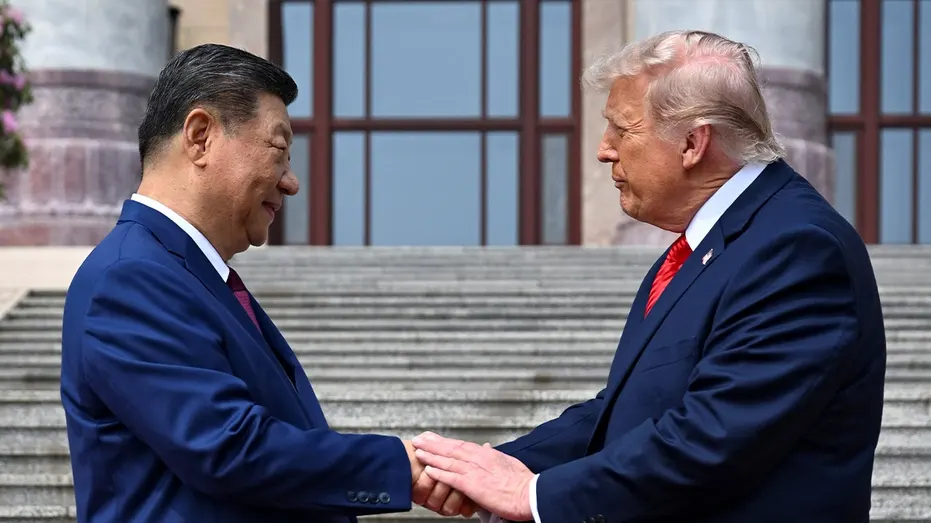
SouthernWorldwide.com – President Donald Trump’s recent summit with Chinese President Xi Jinping was a historic event, sparking questions about whether it marked a genuine breakthrough in ending the “Cold War 2.0” or if China was merely employing its usual tactics.
While the summit itself revealed few concrete details, the White House later released a fact sheet outlining commitments made by Beijing.
Historically, meetings between American and Chinese leaders often bring a surge of optimism. However, there are significant reasons to exercise caution at this particular juncture.
Firstly, the resumption of dialogue with China has, in the past, been used by Beijing to persuade U.S. presidents to delay taking action. During these delays, China has often continued its problematic conduct.
Consider the issue of fentanyl, which has fueled “the deadliest drug epidemic in history.” President Trump confirmed he raised this matter with President Xi Jinping during their meeting.
Xi Jinping has a history of making promises on this issue to U.S. presidents, including to President Barack Obama in 2016, to Trump in 2018, to President Joe Biden in 2023, and again to Trump in 2025. Despite these pledges, China has failed to uphold them.
To his credit, Trump imposed an additional 20% tariff on Chinese goods related to fentanyl last year. However, as Sara Carter, his drug czar, noted in March, China has continued to sell precursors for the deadly synthetic opioid.
Therefore, the time for mere discussion on this specific topic should arguably be over. Yet, the recent summit appears to have allowed Xi Jinping to buy even more time.
Secondly, Xi Jinping displayed an aggressive stance during the summit. He publicly referenced the Thucydides Trap, a concept describing the dangers when a declining power is challenged by a rising one. This reference was seen by many as a pointed remark towards Trump and America.
“Xi’s urging that China and the U.S. overcome the Thucydides Trap and create a new paradigm of major-country relations signals his expectation that the West will accept the inevitability of being overtaken by China and therefore not challenge it anywhere on earth,” Charles Burton of the Sinopsis think tank commented after the summit.
Even more concerning, on the first day of the summit, the Chinese leader spoke of a “new era.” This phrase is Xi’s term for a period where the U.S. is sidelined and China dominates the global stage.
“Change is coming that hasn’t happened in 100 years,” Xi told Russian President Vladimir Putin in Moscow in March 2023, after their 40th in-person meeting. “And we are driving this change together.”
To underscore the significance of this “new era,” the Chinese foreign ministry announced that Putin would be visiting Beijing starting May 19.
As Burton pointed out, “Xi views himself as the modern heir of China’s lineage of great emperors, so the concept of fair and reciprocal relations with any foreign country is simply absent from his worldview.”
Baca juga di sini: Platner Prefers Surrender to Engagement with China
Xi Jinping has long promoted the imperial-era notion that China is the world’s sole sovereign state. Chinese emperors believed they not only held the Mandate of Heaven to rule “tianxia” – “All Under Heaven” – but that Heaven compelled them to do so.
Xi has frequently employed “tianxia” language. “The Chinese have always held that the world is united and all under heaven are one family,” he declared in his 2017 New Year’s Message.
Furthermore, Chinese officials have consistently propagated “tianxia” themes. Foreign Minister Wang Yi wrote in Study Times, the Central Party School newspaper, that “Xi Jinping thought on diplomacy” has “made innovations on and transcended the traditional Western theories of international relations for the past 300 years.”
With his reference to the past 300 years, Wang Yi was alluding to the Peace of Westphalia of 1648, a series of treaties that established the current international order of competing sovereign states. Wang’s use of the word “transcended” implies that Xi desires a world without sovereign states, a unified world, in essence, ruled by China.
The question then arises: how can any nation truly cooperate with a China that dismisses the sovereignty of others?
Charles Payne, a Fox Business anchor, suggested to Jesse Watters that the Trump-Xi summit could be an echo of an earlier dialogue: “This has a chance to become a Reagan-Gorbachev No. 2.”
Payne’s historical analogy appears to be more pertinent than Xi’s own references.
Currently, China is not on a path of steady rise as Xi’s references to the Thucydides Trap and the “new era” might suggest. China’s economy is deteriorating, its property market is in decline, the Communist Party is experiencing purges, the military is in disarray, and a significant portion of the population is either disgruntled or disengaged from society. Most critically, the country’s demographics are in collapse; China is projected to lose more than half its population by the end of the century.
Former Soviet President Mikhail Gorbachev, who navigated a failing state, is widely celebrated as a hero for recognizing the unsalvageable state of the USSR. In contrast, within China’s ruling circles, he is often vilified.
“Why did the Soviet Union disintegrate? Why did the Soviet Communist Party collapse?” Xi Jinping asked in a private address to Guangdong province cadres in December 2012, shortly after becoming the general secretary of China’s ruling party. “An important reason was that their ideals and convictions wavered.”
“Finally, all it took was one quiet word from Gorbachev to declare the dissolution of the Soviet Communist Party, and a great party was gone,” Xi declared in Guangdong. “In the end, nobody was a real man, nobody came out to resist.”
President Ronald Reagan, through his dialogue with Gorbachev, managed to stabilize relations, allowing for the Soviet Union’s dissolution without widespread catastrophe. Xi Jinping, however, appears far more resolute than the Soviet leader, suggesting that Trump’s challenge in managing a faltering China will be considerably greater.