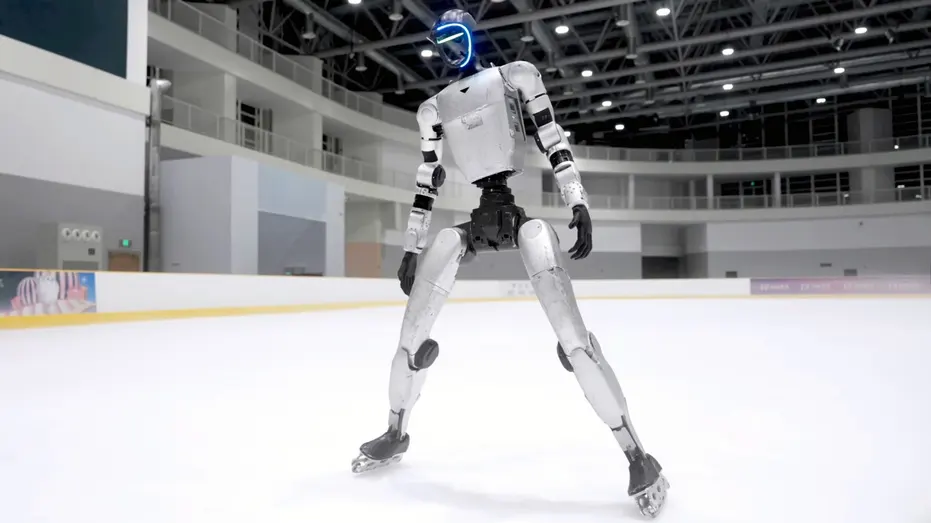
SouthernWorldwide.com – Unitree Robotics has unveiled its G1 humanoid robot, showcasing an unprecedented ability to ice skate and rollerblade with remarkable balance and agility.
While robots have demonstrated capabilities like walking, running, climbing stairs, and even completing marathons, the sight of a robot gracefully gliding on ice like an Olympic skater or executing a spin on one leg on rollerblades without faltering is a novel development.
Newly released footage captures the Unitree G1 robot moving fluidly on both rollerblades and ice skates. Its posture remains steady, a testament to coordinated wheel and leg control. The performance is captivating to observe.
One particularly striking aspect of the video is the robot’s initial movements. It leans into its motion, almost as if stepping, as it propels itself forward on two wheels. The robot shifts its weight from side to side, simulating the gait of one wheel leading the next. Its arms move in tandem to maintain equilibrium, creating a rhythm that more closely resembles walking than rolling, indicating constant real-time adjustments.
The G1 then proceeds to perform a series of spins and an impressive flip, landing cleanly on its two wheels and continuing its movement without any discernible pause or hesitation.
Transitioning to rollerblades, the robot exhibits the same high level of control. It glides, executes intricate footwork, changes direction, and impressively lifts one leg while spinning, all while maintaining perfect balance as if it were second nature.
However, the truly awe-inspiring moment arrives at the end of the demonstration. On ice skates, the robot begins performing smooth twirls, reminiscent of figure skating, all while maintaining its upright posture without slipping. This display highlights the significant advancements made in humanoid robot technology.
A persistent challenge for most humanoid robots has been maintaining stability during dynamic movements. The G1 addresses this by integrating two distinct approaches: the efficiency of wheeled locomotion and the adaptability of legged movement. This allows the robot to achieve speed on flat surfaces and navigate challenging terrain.
The robot seamlessly transitions between these modes in the demonstration. It maintains continuous motion, eliminating the need for stops to rebalance. Viewers can witness 360-degree turns, controlled spins, and even front flips, all performed without any visible interruption.
This level of fluidity suggests substantial improvements in real-time control, balance correction, and motion planning—areas that have historically limited the capabilities of humanoid robots.
The underlying hardware of the G1 is crucial to its impressive performance. Unitree designed the system as a comprehensive platform for AI training and deployment. This architecture enables the robot to collect its own data, learn from simulations, and then apply those learned behaviors in real-world scenarios.
The robot is available in two primary configurations. The Standard model is designed for stationary tasks, while the Flagship version incorporates a wheeled base capable of reaching speeds of approximately 3.3 feet per second.
Both versions feature a humanoid structure with up to 19 degrees of freedom. Each arm possesses seven degrees of freedom and can handle a payload of roughly 6.6 pounds. A flexible waist joint allows for a wide range of motion, which is instrumental in maintaining balance during dynamic activities.
Visual input is provided by a binocular camera located in the head, supplemented by wrist-mounted cameras for close-up visual tasks. The system is also capable of utilizing various grippers, including dexterous hands for performing more intricate manipulations.
At its core, the Flagship model is powered by an NVIDIA Jetson Orin NX module, offering up to 100 TOPS of computational power. This substantial onboard processing capability facilitates real-time decision-making during complex movements.
Battery life can extend up to six hours, contingent on the intensity of the robot’s operational workload.
The field of robotics has traditionally been divided into two main categories. Wheeled robots excel in efficiency but struggle with obstacles, while legged robots can navigate complex environments but are generally slower and consume more energy.
Unitree’s innovative approach seeks to bridge this gap. By equipping a humanoid frame with wheels, the G1 can move rapidly on level surfaces and adapt to changing conditions. This hybrid design also contributes to reduced wear on its joints and enhances energy efficiency over extended distances.
Furthermore, this hybrid design opens up possibilities for a wider array of applications. A robot of this nature could potentially navigate a warehouse, transition to precise manipulation tasks at a workstation, and then move to its next assignment without any loss of momentum.
The ice-skating demonstration is immediately captivating and difficult to overlook. What becomes apparent after a few moments is the robot’s consistent stability throughout the entire performance. It continues to move, adjust, and never appears close to losing control. This represents a significant departure from the stop-and-go movements often observed in current robotic demonstrations.
As robotic technology continues to advance, we can anticipate robots that can navigate real-world environments with fluid motion, without deceleration or the need for constant human intervention.
Read more : Trump to pause gas tax
The compelling question arises: If robots can achieve such fluid mobility today, how long will it be before they seamlessly integrate into our workplaces and daily lives? Are we prepared for this future? We invite you to share your thoughts by contacting us at CyberGuy.com.