SouthernWorldwide.com – As America approaches its 250th anniversary, a powerful prayer attributed to George Washington continues to resonate, offering a profound glimpse into the foundational faith that shaped the nation.
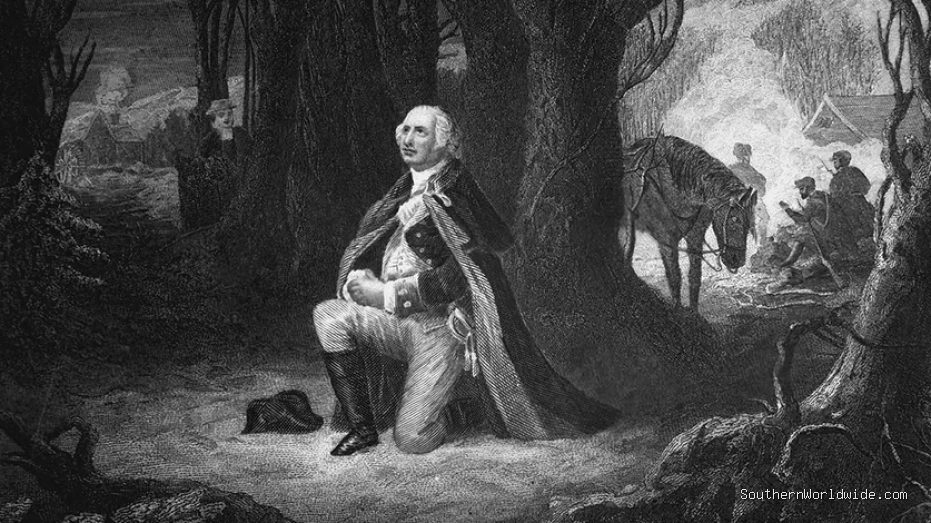
The iconic painting, “Prayer at Valley Forge,” created by Arnold Friberg in 1976, serves as a central piece in the Museum of the Bible’s current exhibit commemorating America’s upcoming 250th birthday. This artwork depicts a scene of deep spiritual reliance during a critical moment in the nation’s fight for independence.
Carlos Campo, Ph.D., CEO of the Museum of the Bible, highlights the significance of Washington’s posture in the painting. He states that Washington is “most powerful on his knees,” emphasizing the general’s acknowledgment of a higher power for true leadership.
The painting captures a moment of immense struggle during the brutal winter of 1777-1778. Washington’s soldiers were facing extreme hardship, enduring freezing temperatures and lacking essential supplies like shoes, making the fight for independence seem like a distant dream.
This visual narrative, presented at the Museum of the Bible, underscores the belief that fidelity to God and faith in divine power were instrumental in the formation of the United States. These were not merely abstract philosophical concepts but lived realities tested in the crucible of war.
As the nation prepares for its semiquincentennial, Washington D.C. is adorned with patriotic colors, celebrating the enduring ideals enshrined in founding documents like the Declaration of Independence and the Constitution. However, Campo suggests that a deeper influence on America’s sense of law, justice, and mercy can be found in the museum’s exhibit, particularly through the portrayal of General Washington in prayer.
The narrative extends beyond the painting to the personal experiences of Washington, as highlighted by Dr. Ben Carson. Carson emphasizes that Washington’s character and divine ordination are often overlooked in modern history education.
Carson recounts an anecdote from July 1755, when a 23-year-old Washington miraculously survived the Battle of the Monongahela. Despite being shot at repeatedly and having horses killed beneath him, Washington emerged unharmed.
In a letter to his brother, Washington described this event, attributing his survival to “the all-powerful dispensations of Providence,” stating he was protected “beyond all human probability and expectation.”
Carson further shares a story from an Indian chief who was present at the battle. The chief, an expert marksman, claimed to have shot Washington seventeen times, with his men also firing at him. He testified that he eventually told his men to stop, believing Washington was protected by a “great spirit above.” The chief sought to meet Washington before his death, recognizing him as destined to become the “father of a great nation.”
This account, Carson notes, was once a common part of American history lessons but has since been largely omitted.
The article posits that entrusting the future of a nation to a leader who deeply believed in the power of prayer might seem risky. However, the subsequent success and endurance of both Washington and America serve as compelling evidence of this faith’s impact.
The Museum of the Bible brings this history to life through a one-man show in its theater. Actor James Denton portrays General Washington not as a stoic historical figure, but as a vulnerable man facing a crisis that would shape the course of history.
The performance highlights Washington’s adherence to biblical teachings, particularly the call to “pray without ceasing” and the promise that if people humble themselves, their land will be healed.
The narrative draws a parallel to Abraham Lincoln, who, decades later, also turned to prayer during another national crisis, the Civil War. Lincoln’s prayer was aimed at preserving the nation, much as Washington’s was to birth it.
Lincoln famously stated, “I have been driven many times upon my knees by the overwhelming conviction that I had nowhere else to go. My own wisdom and that of all about me seemed insufficient for that day.”
The article suggests that for America to fulfill its potential as a global beacon, it had to overcome internal divisions and embody the principle of “e pluribus unum” – out of many, one.
In contemporary times, prayer is sometimes dismissed or trivialized. However, the article argues that prayer possesses genuine power, a concept that churches recognize in their “prayer warriors.”
Campo acknowledges that while Washington might not have been the most conventionally religious, he profoundly understood the “sovereign power of God” and recognized the necessity of invoking that power during critical moments.
As America celebrates its 250th anniversary this Fourth of July, the article concludes by reminding readers that the same divine power that guided the nation’s founders remains accessible today.