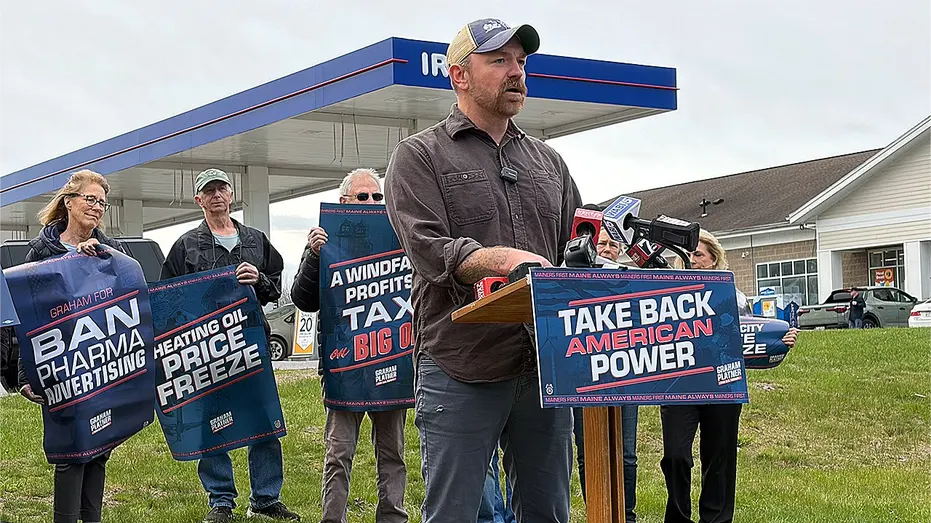
SouthernWorldwide.com – A candidate for the U.S. Senate in Maine, Graham Platner, has proposed an energy security strategy that involves cooperation with China.
Platner, described as a progressive oyster farmer and Marine veteran, has received endorsements from prominent figures like Senator Bernie Sanders and Senator Elizabeth Warren. Recent polls suggest he is likely to unseat the incumbent Republican Senator Susan Collins. He has articulated his approach to dealing with China, which he views as America’s primary geopolitical rival.
“Our position towards China should be one of cooperation instead of one of opposition,” Platner stated, dismissing a confrontational stance towards Beijing as “absurd.”
His reasoning is that a collaborative effort with China on clean energy is essential to combat climate change. The idea is that by working together, the world can transition away from fossil fuels and embrace an era of renewable power, peace, and prosperity.
This perspective, however, is met with significant criticism for several reasons. Firstly, China is identified as the world’s largest polluter and is seen as not prioritizing climate change concerns. Secondly, the future of energy conflicts is anticipated to revolve around the components of clean energy technology rather than fossil fuels. Thirdly, the solution to climate change is argued to lie in increased American energy production and innovation, not in reduced domestic output.
The notion of forming an alliance with China on climate policy is likened to partnering with Iran on nuclear policy or expecting the Amish to develop artificial intelligence—an analogy that highlights the perceived lack of common ground or logical alignment.
China portrays itself as a leader in global clean energy initiatives while simultaneously operating one of the dirtiest major economies. The majority of China’s electricity is still generated from coal, and its greenhouse gas emissions exceed those of the entire developed world combined. Environmental standards in China are significantly laxer than those in the United States, and supply chains controlled by China across Southeast Asia often follow a similar pattern of reduced environmental oversight.
Although China is the leading producer of solar panels globally, this production is achieved at the cost of environmental degradation, affecting its workers, water resources, and neighboring regions, primarily to offer lower prices. This practice allows China to undercut international competitors.
There is a suggestion that China might leverage individuals like Platner as a symbol of its environmental efforts, similar to how historical figures have been used for propaganda. This comparison is drawn to a New York Times reporter who received a Pulitzer Prize for reporting that downplayed the Soviet Union’s role in the Holodomor, a man-made famine in Ukraine.
The vision of future energy scenarios, as imagined by some environmental advocates, involves a harmonious coexistence powered by clean energy. However, this idyllic picture overlooks China’s dominant position in the supply chain for critical minerals essential for clean energy technologies. This control extends to wind turbines, solar panels, and electric vehicles.
According to the International Energy Agency, China holds a leading position in refining 19 out of 20 critical strategic minerals, with an average market share of 70%. Furthermore, China controls over 80% of the global midstream and downstream segments of the battery supply chain, with some categories seeing near-monopoly shares of 95% or higher. Essential materials like lithium, cobalt, graphite, and rare earth elements, which are fundamental to clean energy technologies, are processed in China before being distributed worldwide.
The argument for increased cooperation with China is thus challenged by the fact that China has already begun to exploit its dominant position. In 2025, Beijing implemented stringent export controls on lithium-ion battery supply chains, affecting battery cells, cathode materials, and manufacturing equipment. Earlier this year, Chinese export controls on rare earth elements drastically reduced U.S. yttrium imports, causing prices to surge significantly.
These circumstances do not justify abandoning clean energy development. The global energy challenges, such as those experienced in the Strait of Hormuz, underscore the necessity for the United States to diversify its energy sources. Instead of yielding to China’s dominance, the U.S. is urged to enhance its domestic production of critical minerals and clean energy technologies, a strategy that has been pursued by the Trump administration and is supported by legislation like the DOMINANCE Act.
The effectiveness of environmental protection is argued to be greater through American initiative rather than collaboration with China, a country characterized by its monopolistic practices and significant pollution. The American shale revolution, despite criticism from environmentalists, is credited with reducing U.S. emissions to a 25-year low during President Trump’s first term. Additionally, advancements in AI-driven data centers are expected to spur the largest private clean energy expansion in U.S. history, driven by market forces. Moreover, U.S. manufacturing is noted to be nearly four times more emissions-efficient than that of China.
Economic growth, technological innovation, and well-conceived environmental regulations have been more effective in reducing carbon emissions than any international accord or China’s production capabilities. The argument concludes that the United States does not require China’s assistance to address climate change; instead, an “America First” approach to environmentalism is advocated.
Baca juga di sini: Platner's Reddit Post Reignites Controversy with Mocking Remark About Wounded Soldier
Platner’s reluctance to adopt a hawkish stance towards China is his prerogative. However, the notion that cooperating with an adversarial nation, which pollutes extensively and controls the clean energy supply chain, is the path to peace is deemed not only misguided but also dangerous.